Aldous Harding’s new album Train on the Island reminds you of how, as a child, you would mostly mishear the lyrics of English-language songs and sing them back wrong – and precisely through that, build a wholly personal relationship with them. Harding’s music works in a similar way: at the beginning of the creative process, these lyrics probably existed as mere noises, as sounds that only gradually condensed into words.
With Harding, language is texture, wildly mixed paint with which she smears her strangely shaped canvases. At times, Train on the Island has something of freestyle about it, as though she were allowing this word-painting to emerge from within her in real time.
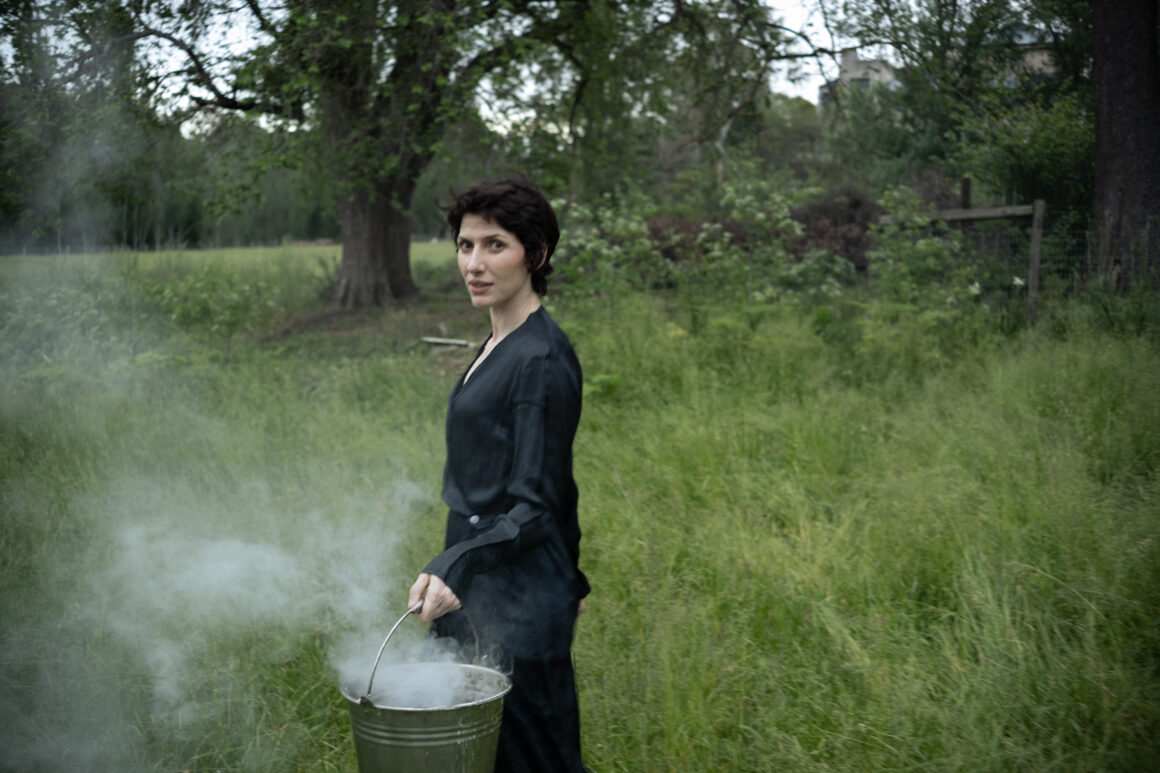
When Aldous Harding performs, she often looks as though she herself is bewildered by what she is producing.
What stands out immediately is that voice – or rather, voices. At least once a week, I think of a quote by indie god and former Smiths guitarist Johnny Marr, who once said it must be terribly boring to be the same person every day. Accordingly, we idolise musical chameleons such as David Bowie, who lived precisely by that principle. But what is special about Aldous Harding is not that she has changed her voice over the course of her discography, but that she constantly transforms her singing even within a single album. One moment Harding sounds squeaky; the next, suddenly deep and smoky.

Most recently, it was Cameron Winter, singer with the acclaimed rock band Geese, who reminded me once again that the best vocalists often have something meme-like about them: they are easy to parody and are constantly on the verge of the ridiculous. I remember well the first time I heard about Aldous Harding: friends were making fun of the way she pronounces the word »Party« in the song of the same name from the 2017 album of the same name; Harding incorporates her New Zealand accent quite naturally. To draw a comparison with one of the greatest song performers: Bob Dylan’s music is so much fun precisely because no one would seriously think of singing like that. You can rub up against it.
Meaning unclear, effect enormous
A comparison that at first seems unsuitable: Lil Wayne. Much like that rap icon, Aldous Harding strings together lines that appear to have nothing to do with one another. When Train on the Island was sent to me for the purposes of writing this article, I wished I had a lyric sheet – not only because I do not always understand what she is singing, but also because I would have been interested to see how these words work on paper. What does it all mean, anyway? Perhaps that is not the decisive question. Things are often more enjoyable when they do not fully disclose themselves – films such as Mulholland Drive or Spirited Away, for instance. One keeps returning to them.
Harding deliberately avoids interpretations of her songs. When she performs, she often looks as though she herself is confused by what she is producing. In truth, though, this music lives from a constant act of interpretation – not only of words, but also of structures and melodic trajectories. Classical singer-songwriters armed with acoustic guitars occasionally stumble upon something that, for once, sounds refreshing, and then build it in as a bridge or outro.
In Aldous Harding’s music, many songs consist almost entirely of moments in which the singer herself doesn’t seem to know exactly what she’s doing.
With Aldous Harding, by contrast, many songs consist almost entirely of such moments: those instants in which the performer herself does not seem to know exactly what she is doing. She lets intuition guide her, places a finger on an unusual part of the fretboard – and suddenly her own voice presses off in new directions. Harding keeps arriving at unexpected harmonies and finding idiosyncratic turns within them. Train on the Island is not an explicitly experimental album, but it is one that follows patterns towards which more conventional artists would hardly tend. Aldous Harding draws from a source to which apparently only she herself has access.