
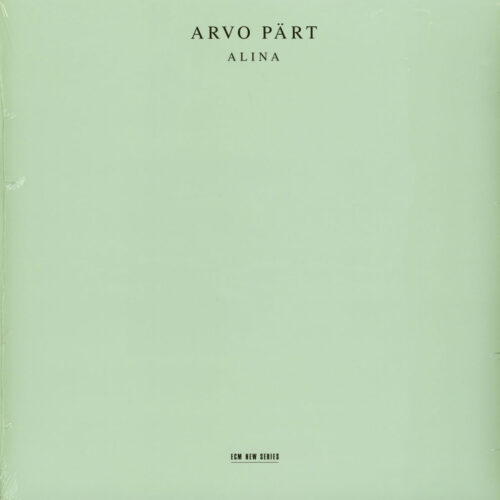
This was the piano piece with which things really began. In »Für Alina«, the Estonian composer Arvo Pärt arrived in 1976 at his tintinnabuli style, in which he combined melodic notes and triads in such a way that they recall bells. An octave in the bass, above it the melodic and harmonic notes follow, slowly, searchingly, without any recognisable goal, yet still gathered. An extreme work in its entirely self-sufficient apparent simplicity. In any case, Pärt’s music did not fit the doctrine of socialist realism, was not repetitive enough for minimalism, and one could certainly not come at the avant-garde with quiet beauty such as this.
On Alina, the pianist Alexander Malter plays the composition in two slightly different versions, in which it is above all the rubato, the delay or shortening of the tempo, that varies. They are framed by no fewer than three interpretations of »Spiegel im Spiegel« from 1978, twice played on violin and piano, once on cello and piano. The title is meant literally: the melodic voice, with its long-held notes, is mirrored in itself, as is the piano part, which with its very quietly circling arpeggios in turn mirrors the melody. It seems almost harmlessly friendly, yet Pärt’s construction develops, despite its supposed sluggishness, a gently violent pull. One may call it magic. For the 50th anniversary of »Für Alina«, ECM has now also released a vinyl version of the recordings.