
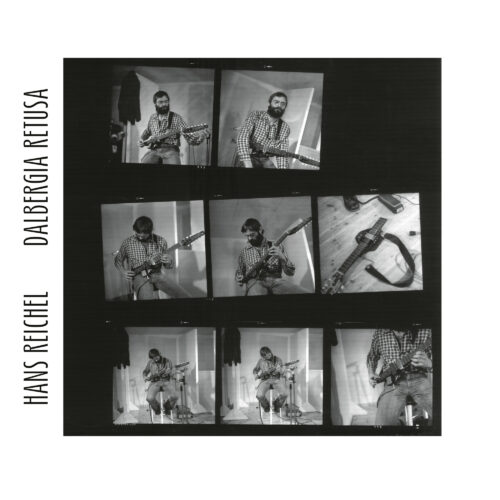
One has to imagine Hans Reichel as a kind of goblin figure. The musician from Wuppertal transformed free jazz in Germany in a wholly singular way through his self-built instruments: guitars whose mechanics he modified or expanded, and later his daxophone, a sort of clamping block into which specially shaped pieces of wood or stone could be fixed in order to produce strange utterances.
The compilation Dalbergia Retusa introduces Reichel as a guitar innovator and presents his shaggy improvisations, in which metallic overtones meet creaking wooden sounds. Reichel’s inventiveness even extended to the materials themselves: he worked with woods such as cocobolo, to which he devoted an entire album, Coco Bolo Nights.
It is a good decision that the selection, assembled by Oren Ambarchi, is limited to Reichel’s solo guitar music from the years 1973 to 1988. For what he achieved with his principal instrument alone remains astonishing. Musicians such as the likewise innovation-minded Fred Frith drew inspiration from him. At times, Reichel’s concentrated playing might be mistaken for a slightly frayed form of folk music, in which harmonies are not so much dissolved in the sense of free harmony as additionally charged, through the construction of his instruments, into a highly distinctive buzzing song.
Reichel did not have to make his living from this. He earned it as a typographer. That independence unquestionably helped him. It allowed him to create beauty without regard for anyone else.
Dalbergia Retusa

