
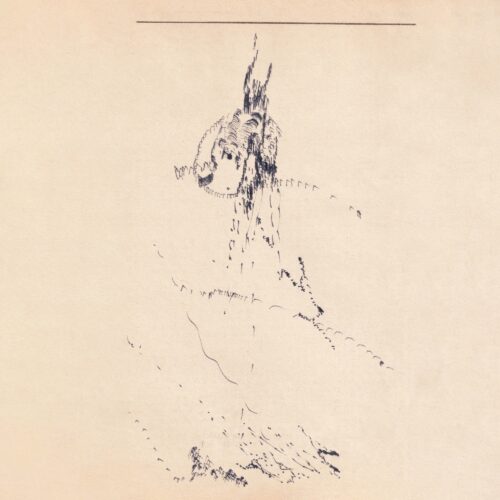
The curve stands for processes rather than states: movement, time, expectation, transience. Becoming rather than being. This is exactly what L. Jacobs negotiates on his second album Behind the Great Curve, five years after Enthusiasm (2021, W.E.R.F.). Jacobs comes from the Ghent scene: the project MDCIII connects him with Matias De Craene and Simon Segers (Black Flower); for Behind the Great Curve, he brings in Milan W. as co-producer, as well as Joachim Badenhorst on clarinet and Sarah Yu Zeebroek on vocals.
The opening is as sparse as could be imagined: a clarinet tone in a loop, flowing water, children’s voices somewhere. Little material, much image – it recalls Kankyō Ongaku, that Japanese environmental music of the 1980s, in which sound inscribes itself into architecture and everyday life rather than imposing itself. The title, too, reveals the direction: »Talk to Mt. Inari«, named after the Kyoto mountain whose pilgrimage path winds through thousands of torii and more than 10,000 steps – the curve, already set in the opening. What follow are states, not stories. Individual splashes of colour. Only with »A Joyous Whistle« does the image tilt: whistling becomes narrative, colour becomes line, the instruments begin to play with one another rather than alongside one another. Entirely in the manner of Ennio Morricone, what becomes audible here is the instinct for transporting maximal images with minimal material.
After 36 minutes, it becomes clear: whoever asks what lies behind the curve is asking the wrong question. Namely one that seeks only a destination where there is a process. Behind the Great Curve does not describe what is coming, but what already lies behind. A consolation that does not explain itself, but settles in. No being. A becoming.
Behind The Curve