

More than a few ballet audiences have been left feeling slightly dizzy since Jlin began conquering opera houses, too. The US producer is now one of the most renowned producers of our time. With her lightning-fast, syncopated beats, she has, in a sense, won over clubs and palaces alike.
The 39-year-old Jlin could not have dreamed of any of this in childhood. Gary, Indiana, a city with around 70,000 inhabitants today, is hardly known as one of the cultural centres of the United States. Quite the opposite: aside from the Jackson Five – and their youngest offspring Michael, who is said to have achieved a certain degree of prominence – the city is best known for having long been one of the centres of the steel industry. A classic Midwestern industrial city, one of those stretches of land where Donald Trump has since found his core electorate.
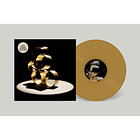
Akoma Golden Vinyl Edition

Perspective Clear Vinyl Edition

Autobiography Red Vinyl Edition
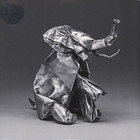
Black Origami
Like everyone else, Jlin worked in the steel industry for a long time. Alongside that, however, she was early on so deeply impressed by the footwork veterans of nearby Chicago that she began trying her hand at producing rapid cascades of beats, flipping samples and walls of bass herself. Her productions quickly began circulating, were celebrated and found their way onto the Planet Mu compilation Bangs & Works, which popularised footwork outside Chicago and especially in Europe, giving artists such as RP Boo, the much too early departed DJ Rashad, Traxman and DJ Nate the long-deserved spotlight.
Jlin, one of the few women in the footwork world, quickly stepped out from the shadow of this first generation, having developed an idiomatic style that does not understand her own tracks purely as dance music. Jlin’s ambitions are larger: she sees herself as a composer, as someone who might connect with minimal music, ballet and concert halls. She has long since earned the respect of other exceptional figures such as Björk and the composer Philip Glass – and has long since collaborated with both.
I think we need to address the elephant in the room: you are playing Enjoy Jazz Festival this year. Jazz is not the genre people have generally associated with your music. What were your points of contact with jazz in the past?
Jlin: My father was very enthusiastic about jazz; he played his records all the time. In Gary, Indiana, where I grew up, there was a jazz radio station called WNUA 95.5 that my parents listened to day in, day out. So my socialisation with jazz began very early – even though I didn’t know all the names. My parents had different favourites: my father listened to and loved Miles Davis, John Coltrane, Alice Coltrane, Tito Puente, Charlie Parker. My mother favoured Jonathan Butler.
In jazz, you play against time.
Jlin
For you, as someone born in the 1980s, did jazz ever feel like a relic from the past – something belonging to an older chronology, in stark contrast, for example, to the electronic music that was so present in the 1990s?
Jlin: Jazz will never feel outdated to me. The music has always determined my present and my future. Do you want to know why? In jazz, you play against time, you play outside time, you play different rhythms and with ever new, unpredictable moments. Those are techniques I also use in my music. And not only me – many electronic musicians and producers do. Jazz will therefore never be a bygone genre; it is the foundation I stand on!
And which records, developments or acts from the wide world of jazz interest you – either personally or professionally?
Jlin: Kenny G – whose technique I adore – Al Jarreau, Anita Baker, Chaka Khan, Jonathan Butler, Tito Puente, »Take 5«. I had to name that piece because it is very important to me. Everything builds on »Take 5« for me. Those are the records that never grow old. Then Sade, my favourite artist, though she is not a jazz musician. In general, I have problems with categorising artists: the best ones are much bigger than any genre term.
Let’s enter your own musical cosmos: in 2011, most scene heads and interested listeners first noticed you through your track on the Bangs & Works compilation. Looking back, did you experience the hype that emerged in the US and Europe as wholesome, or as appropriation and short-term hype?
Jlin: No, I didn’t understand it as cultural appropriation at all. What I perceived, rather, was that from 2011 onwards, footwork finally got the attention this incredible sound had long deserved. Do you know what those many men and few women had been building and producing for years? I was simply happy that the world recognised and acknowledged it. For me, footwork was a jewel the world needed to see.
And for yourself, with regard to the music you composed in the following years and still compose today: did you see yourself then, or ever, as a footwork producer?
Jlin: At first, I wanted to be part of it; I thought I was a footwork artist. But it was my mother who pointed out to me that my sound was … different. Of course, I used features and elements of footwork, but the music was not footwork. I only realised that around 2016 or 2017. That was also the moment when I was able to let go, when I was signed, when everything developed and changed: how I thought about and made music. Working with the choreographer Wayne McGregor on the dance piece Autobiography changed my access to my own pieces. That is the real beginning of my career. Where at first I wanted to be part of the footwork movement, afterwards I only wanted to find a space in which I could realise and develop myself.
Over the past few years, the inspiration of minimal music – it is known that you are an admirer of Philip Glass – has become clearer in your tracks. Looking back especially to the 1970s, there was a very productive and intuitive period in which jazz and minimal music came together and sometimes became indistinguishable. Terry Riley played with Don Cherry; Kelan Phil Cohran made African Skies, and so on. Is that something you have engaged with? Can you connect with it yourself, or do you see yourself in a tradition there?
Jlin: Collaborations, like the one you mentioned with Philip Glass, arise naturally; if they are meant to arise. »The dice fall as they fall« – that is the kind of person I am. I don’t follow a plan; it all just happens. And for me, that also applies to sound: whatever touches me today is simply meant to be that way. Then I surrender to the movement. Today, and in recent years, that has been classical music and minimal music; tomorrow it may be more strongly related to jazz again. The day after tomorrow it might be drumming. My spirit will take me to where I creatively belong at that moment.
While your spirit guides you, your tracks are certainly capable of confusing listeners. It is almost exclusively unconventional song structures and more complex drum settings that evoke a feeling of unease, or even fear. One has to make an effort to keep a cool head. Is that intended by you?
Jlin: No, I just make music. So I don’t have any particular focus – such as deliberately complex song structures. My music works with many layers, but unease or anxiety are not what I want to evoke. It is simply an expression of myself.
The question of what one hears in my music is therefore not one that should be put to me.
Jlin
At the same time, I had to think of how your most recent record Akoma and its dramaturgy reflect precisely this development – the second half of the record gradually offers more support, without losing complexity. Did you want that feeling of »coming back home«?
Jlin: Akoma, like all my music, is influenced by the space or the stories that surround me. But I’m not sure right now how and where Akoma came about. I can, however, relate very much to that feeling of »coming home«: often the music comes back to me, changes, takes on a new form and then finds its way into the next piece again.
For years, people claimed that in the tracks of Detroit techno producers one could hear a closeness to engines and car factories. Can the steel industry, which was your home until 2015, still be recognised in your music?
Jlin: I love the sound of industry; sometimes, anyway. That is why such sounds will break through and find their way again and again. But honestly, I think it depends more on the listener than on the musician. The question of what one hears in my music is therefore not one that should be put to me.
Four months ago, you posted on Instagram that you were working on a new album. Can you reveal anything about that yet? Or about other projects currently coming up?
Jlin: I’m currently working on a piece for the Green Umbrella series of the Los Angeles Philharmonic. [Green Umbrella is a programme series for contemporary new music in Los Angeles. It celebrates its 40th anniversary in 2027. Interviewer’s note.] It is a 12- to 15-minute piece, and I’m making good progress with it. I’m also working on an album, that’s right, but I’m not ready to reveal more yet.
Buy tickets