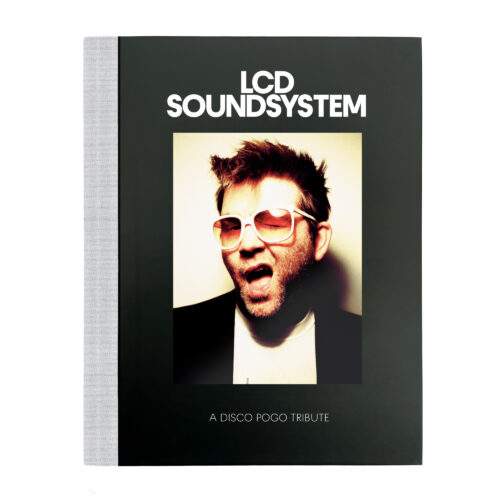
Clear-eyed about its zeitgeist and simultaneously a product of it: LCD Soundsystem. Still active and thriving, the New York band already carries a long, tangled history. DFA Records was founded in 2001; »Losing My Edge« (2002) became a generational anthem; several peaks followed before the first split in 2011; the reunion came in 2016. LCD Soundsystem became chroniclers of a generation whose sound stretches from the turn of the millennium into the present.
The new book A Disco Pogo Tribute – LCD Soundsystem unpacks this history. Unlike conventional biographies, the book – following the Aphex Twin tribute (2024) – avoids a linear narrative and instead approaches the zeitgeist in the manner of an oral history. A blend of text excerpts, timelines, essays and original articles condenses several decades of music history into digestible parts that should delight long-standing fans (and anyone who might become one). The result is not only a portrait of the band but, above all, a vivid rendering of an era in all its colour – a collage that reflects a scene with both nostalgia and journalistic acuity, without drifting into academia yet full of meticulous detail.
From the early days at Plant Bar in Alphabet City – which became a hub for figures like Marcus Lambkin (Shit Robot), Dominique Keegan, Tim Goldsworthy, as well as Miss Kittin, The Rapture, Metro Area and Le Tigre – to the tension between rock and club culture, and the post-9/11 mood of a generation for whom partying became a form of resilience, the book traces the conditions under which a band like LCD Soundsystem invented itself in tiny bars and studios.
Caught between a generational shift – the 1990s club era giving way to an emerging, digitally networked 2000s pop logic – LCD Soundsystem’s commitment to authenticity and self-irony became a survival strategy in a post-analogue musical landscape. Frontman James Murphy also appears as a human projection surface, an artistic persona whose flaws (workaholism, a penchant for control) are given full weight. Particularly striking is how the book, through its contextual approach to a moment when music was being rethought from the ground up, anticipates the streaming age – one in which music history no longer »belongs« only to connoisseurs but to the wider public.
One of the pleasures of this oral-history format is that the protagonists are not merely discussing the band but reflecting on their own roles within this story. One might ask how much of it is embellished or interpreted. Yet it is precisely this subjective polyphony that gives the book its pull.