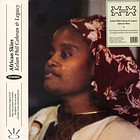

The origin story of African Skies reads almost more adventurously than the music itself sounds. Recorded in 1993 but not released until 2010, the album has since come to be regarded as a late milestone of spiritual jazz, with copies commanding sometimes astronomical prices. The astronomical metaphor is apt: the music was originally commissioned by Chicago’s Adler Planetarium to accompany a multimedia programme titled African Skies, which featured photographs from African observatories. For multi-instrumentalist Kelan Philip Cohran, the connection between Africa, cosmology and music was nothing new. He absorbed his lessons in Afrofuturism in the late 1950s and early 1960s with the Sun Ra Arkestra, later developing these ideas as a leader with the Artistic Heritage Ensemble and The Hypnotic Brass Ensemble.
The music on African Skies feels enigmatic, at times psychedelic, and reaches far beyond the boundaries of spiritual jazz. This is partly due to the instrumentation: two bassists, two harps, a range of percussion instruments, and Cohran himself on trumpet, guitar, flute, violin, percussion and the Frankophone – a self-built electric kalimba – hardly resemble a conventional jazz line-up. Equally important is Cohran’s insistence on foregrounding the African heritage of jazz, a principle that also shapes this work.
Yet, like all major innovators, he reprogrammes the past in such a way that it retains relevance in the present. Cohran dedicated African Skies to his mentor Sun Ra, who died just a few weeks after the recordings were made.