
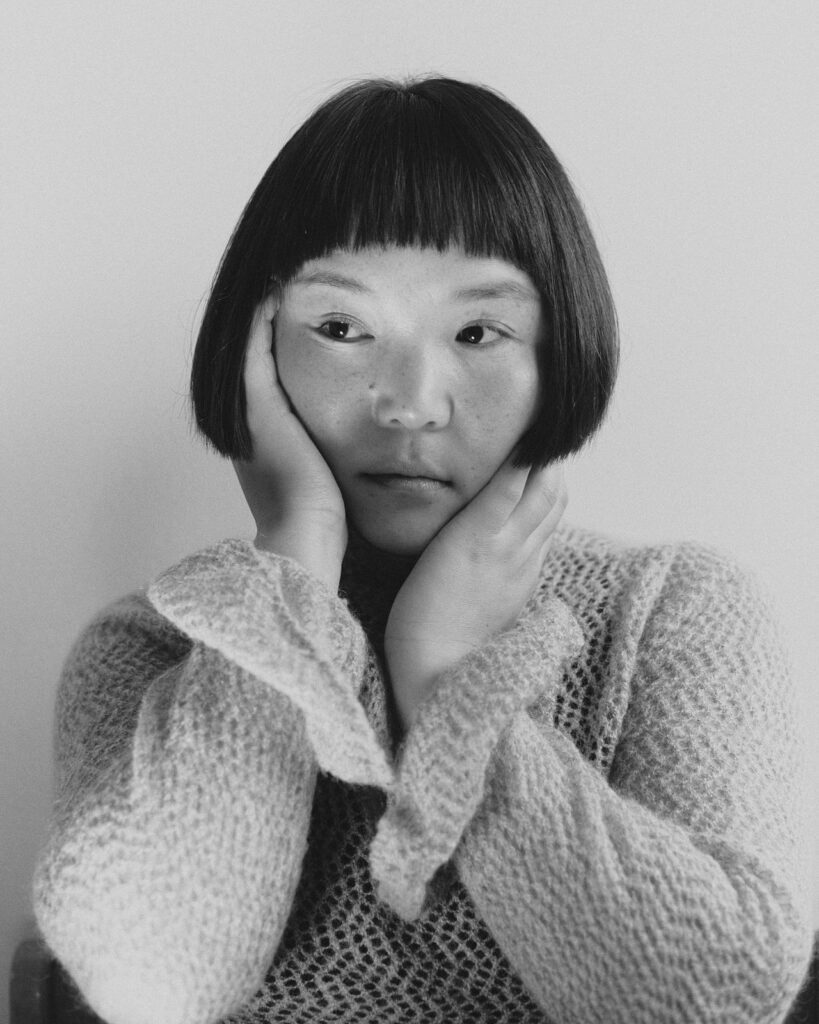
»My teachers were a bit disappointed when I suddenly decided to study music after graduating from high school,« says Enkhjargal Erkhembayar, better known by her artist name Enji. Back then, she recalls, music education was scarce at her school in Mongolia’s capital, Ulaanbaatar. Enji excelled in chemistry. All the more surprised were those around her when she turned toward music and, via a few detours, eventually ended up in Munich.
Already in 2021, her album Ursgal had critics at Deutschlandfunk Kultur raving about her “unique blend of jazz and folk rooted in Mongolian song traditions.” Her new album Sonor (Squama) proves that Enji is far more than a novelty act. While the play between Mongolian, English and German lyrics is essential to her work—and her weaving together of diverse song traditions quite remarkable—tracks like »Eejiinhee Hairaar« possess a timeless, placeless quality. With a poise and elegance steeped in 100 years of jazz history, and backed by some of the German scene’s finest (Elias Stemeseder, Robert Landfermann, Julian Sartorius) as well as co-writer and producer Paul Brändle, Enji invites listeners into unfamiliar-yet-intimate sonic landscapes.

How did you get into jazz in Mongolia, and what role does jazz play there today?
Enji: There was already some jazz in Mongolia in the 1980s—bands like Bayanmongol (jazz, folk, funk) tried to create jazz contexts. There’s even a big band that’s been around for more than 50 years. But they performed mostly at large concerts, and as a young person, I had no real access. I’d say jazz only truly came to life in Mongolia about eleven years ago. Personally, I didn’t discover it until 2014 through a project called GMUB.
You mean the Goethe-Institut’s jazz initiative at the Mongolian State Conservatory.
Yes, that’s where Martin Zenker taught subjects like harmony and ear training. Before that, I had no clue about any of it. The GMUB project involved a lot of young people and made jazz part of our daily lives. Today, there’s even a great jazz club in Ulaanbaatar called Fat Cat, which a friend of mine opened. They host concerts every day, and the audience is mostly young people.
Would you say there’s a distinct Mongolian form of jazz?
I’m not sure there’s a jazz style that’s purely Mongolian. There are musicians who love playing bebop, straight-ahead or swing and work consciously within those traditions. But the beauty of jazz is its freedom—you can bring in your own voice and your own story. That’s why you can often hear a person’s background and personality in their playing.
How do you see the relationship between the harmonic systems of Western jazz and Mongolian musical traditions?
Traditional Mongolian music is pentatonic and harmonically very natural, while jazz—with its chords and improvisation—is much more complex. At first glance, the two worlds seem totally different. But Mongolian music also has that spiritual freedom, imagination and a strong storytelling element—there’s improvisation there too. So for me, it’s not about trying to make them fit; it’s more like a dialogue between two languages.
»I won’t stop trying until the song feels right at home.«
Enji incorporates many languages into her music
You sing in Mongolian, which often sounds unfamiliar to Western ears. Do you find Mongolian a musical language?
Absolutely. Mongolian is very musical—especially poetic and rhythmically rich. But what really fascinates me is how you can make music in any language. Every language has its own beauty and strength.
Now you also use German and English in your songs. How did that come about? Do different languages evoke different emotions or ideas for you?
Sometimes it’s just the sound that draws me in, sometimes it’s a different way of telling a story. I often try multiple approaches—like writing lyrics in English and realizing during the process that it feels off. So I keep working at it until it feels like home.
What brought you to Munich?
Originally, I came to record my first album—in December 2016, just for ten days. Back then, I never imagined I’d end up living here. But life had other plans. In 2018, I moved to Munich to do a Master’s in jazz vocals. During my studies, I met the people I now make music with—Squama Records, musicians—and that’s become an essential part of my life.
Ursgal was your second album, but your first on Squama. What drew you to the label?
What I really appreciate about Squama is that we share the same attitude toward music: creative, innovative, and not trying to adapt my story for an algorithm. It’s about making real, good music. They make me feel heard and supported. I have the freedom I need, but also real dialogue—and that’s incredibly important to me. Every project is made with heart, and that leads to special collaborations.
How would you describe the development from Ursgal to Sonor? What experiences shaped the new album?
Ursgal and Sonor both capture a moment in time. Ursgal reflected where I was back then, while Sonor expresses who I am now. I’ve gained a lot of experience since—through concerts, collaborations and just life in general. That’s shaped my music and helped me find my voice more clearly and tell stories more freely. Sonor is more open, more courageous, and more personal.
Do you see that as a big leap, or more like subtle shifts?
Both, actually. It shows what music has allowed me to do in a short time and how grateful I am that people are listening. So yes, a big leap. But each album captures a particular moment. The changes often lie in the details—in how I improvise, tell stories or use my voice. It’s not about suddenly doing something completely new, but about moving forward step by step and making those small changes visible.
What does your songwriting process look like? Do you start with lyrics or melodies?
It varies. Sometimes I start with lyrics, sometimes with a melody or chord progression. Often, the song takes shape during the process. What’s important to me is not to miss the moment—whether it’s a lyric or a voice memo. My ideas often come to me naturally and very visually. Then I just try to describe what I’m feeling.
Related reviews

Do you have an “Enji trick”? A go-to chord progression or rhythm that you like to return to?
Not really. The stories I tell are always different. But of course, there are elements I’m drawn to: I’ve written four songs in the same key, just by chance. I like odd time signatures with unexpected turns. I’m also a big fan of strong lines. And my most powerful tool is the words—they just have to be right.
You now play bigger stages, including festivals like Enjoy Jazz in Ludwigshafen. How do you translate the intimacy of your music onto those larger stages?
It might sound cliché, but every space is important and has its own dynamic. It always depends on where I’m playing and how the audience behaves. Playing in China feels completely different from playing in the Netherlands. It’s fun to sense those nuances and try to respond to them—basically to understand the audience.
One last question: Do people in your audience sing along—even if they don’t speak Mongolian?
Yes, it’s happened! Someone in the audience once sang along, and I thought they were Mongolian—but they weren’t. They had just learned the song by heart. At some concerts, I invite the audience to sing with me, like on the song »Duulnaa«. Sometimes it’s just one word, but it always works well and creates a beautiful connection.
Translated from the original German. Due to the nature of translation, some phrasing may differ.