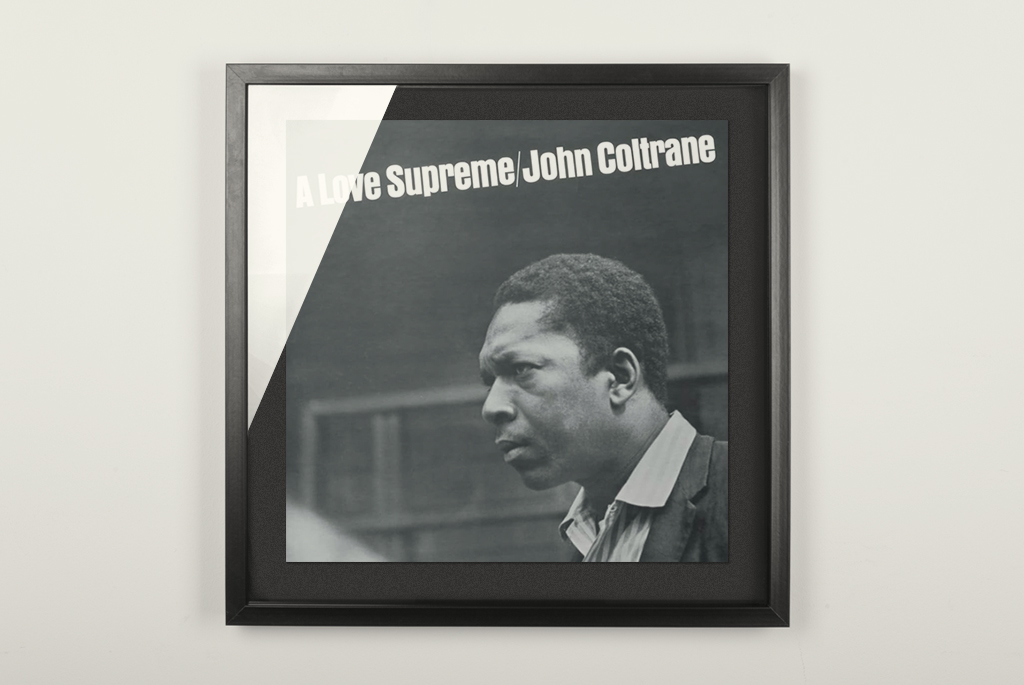
It is perfectly safe to call A Love Supreme one of the great classics of jazz. But is it John Coltrane’s finest album? In his 2011 Coltrane biography, author Karl Lippegaus notes that “many, despite its phenomenal and lasting success, do not consider it his best record.” Fair enough. One could also argue the opposite.
Several elements converge on this album that, when viewed soberly, feel almost extraterrestrial. First and foremost, there is the classic John Coltrane Quartet in magnificent form. Lippegaus even states: “Each of the four musicians is at the height of his abilities.” Pianist McCoy Tyner, bassist Jimmy Garrison and drummer Elvin Jones interact in a way that phrases like “listening to one another” can only approximate. Their playing is so focused, restrained and outwardly unstrained that the effort behind it goes almost unnoticed – a “climb of a high mountain”, as Lippegaus puts it. It is hard to believe that the entire album was recorded in just a single day.
hhv-buy id=1291293]
Then there is the clarity of the structure: Coltrane conceived the record as a four-part suite. The individual movements form arcs that seem to carry far beyond their respective durations. One also cannot avoid the word »breath«. With its elongated melodies, its steady yet driving rhythms and its seemingly simple composure, the suite feels like a long prayer. In numbers: 33 minutes. That takes air.
It is no coincidence that A Love Supreme is considered the founding document of what is now called »spiritual jazz«. Coltrane was reportedly inspired by personal visions while composing the work; the titles of the individual parts evoke church liturgy, the final one even bearing the explicit name »Psalm«. The melodies move forward calmly, with the notable exception of the more clearly syncopated second movement, »Resolution« – the album’s energetic core.
Supreme Love, Ultimate Freedom
And then there is Coltrane’s voice at the end of the first movement, »Acknowledgement«. Used here for the first time on an album as an instrument, it was recorded multiple times, creating the impression that the entire quartet is singing together as a small choir. The three words »A Love Supreme«, murmured rather than sung, repeated over and over again, have often been described as a mantra. At worst, that might reduce them to a kind of incantation. In fact, it is a hymn of praise – perhaps to God, but explicitly Coltrane praises nothing other than love itself. Unwavering, without individual expression, he simply affirms the magnitude of the love he invokes.
Although A Love Supreme helped usher spiritual jazz into being, Coltrane did not continue to pursue this style. Instead, the album proved to be both the culmination and the endpoint of a development, marking the transition towards something else. Coltrane immersed himself ever more deeply in his vision of free jazz, beginning with Ascension, likewise driven by a spiritual and cosmic ambition. Not all of his fellow musicians followed him down that path; the quartet soon disbanded. It is conceivable that, for them, things simply could not get any better after A Love Supreme.