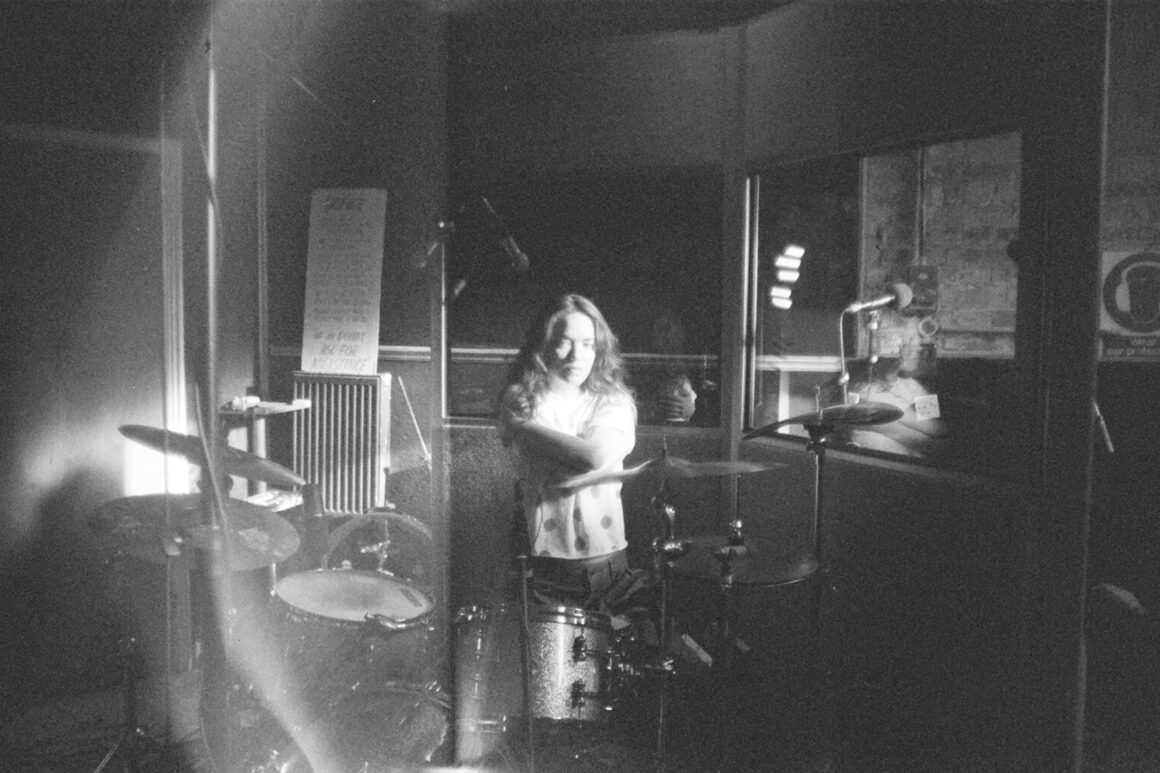
There is a pianist, a guitarist and a singer in Momoko Gill’s family. So she chose the drums as her instrument. That was how she made herself heard.
The musical path of the Londoner, who grew up in Japan and the US, has been anything but linear. Momoko first studied anthropology and sociology, later working for a television broadcaster. It did not suit her. What she really wanted was to make music, though for a long time she did not dare. The turning point came during the pandemic. Today, she not only sits behind the drum kit, she also writes her own songs and sings.
She does so with an experimental impulse that makes her difficult to pin down musically. Then again, the London newcomer moves within a scene that intertwines jazz, electronics, hip-hop and world music.
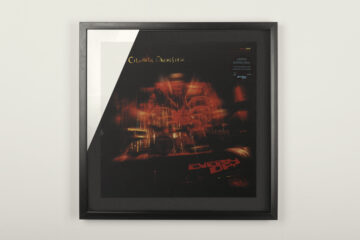
Last year, Momoko released the album Clay together with producer Matthew Herbert, known for his work in electronic music. It sounds very much like pop music and the dancefloor, quite unlike her solo debut, which has now appeared. On Momoko, she enters the darker waters of trip-hop, rethinks sonic beauty and, above all, makes clear who is setting the pace.

Momoko
With a steady hand into controlled chaos
As a drummer, Momoko makes sure her rhythms have enough room to breathe. From varied drum patterns to sounds that sometimes support the groove and sometimes work against it, right through to the production, the autodidact leaves no stone unturned until the song finally stands.
She began writing in order to find out what she was feeling. Clarity: an important motif in her music. That is also why, in her singing, Momoko pays very close attention to how melody, sound and harmony interact. »I kept creating things that needed a central focus to hold everything together«, she says.
Precisely because she knows what she is doing, she temporarily dissolves the structure. With a steady hand into controlled chaos. You can hear it clearly on the jazzy »No Others«. The song is about places where a line is drawn between people: airports, police stations, job centres. One person usually tells the other where to go; the other has to identify or explain themselves.


From the head to the heart
Musically, Momoko translates this power relation by working against the beat – and overrides it directly by placing herself above her own rhythm. After driving drums over rapidly plucked double bass, she decisively hits the brakes for the chorus and sets her contemplative voice against the groove. »I wanted my verses to sound groovy and simple enough to leave more space for more complex harmonies in the chorus«, she explains.
Something similar happens in »Rewind/Remind«, which combines East Asian influences with dubby trip-hop bass from Bristol. In the song, Momoko struggles with being present in the here and now, wallowing in loneliness and melancholy. She is still troubled by the conformity of a person who was probably once close to her. In place of electronic synths come vocalisations that subtly undercut the beat. Momoko is the boss, after all. When she wants to, she indulges the rhythms – with a gentleness that breaks open even the most cerebral arrangement. In this way, jazz sounds move from the head to the heart.
You’ll never move on if you don’t clean up.
Momoko Gill
The heart opens when »When Palestine Is Free« begins. In the final third, Momoko once again reduces the tempo and plays the drums as though the song were ending: lots of free playing, lots of drum rolls. The horns in the background keep going. For a moment, they sound unsettled and seem to hesitate before the drummer catches them and pulls them back into rhythm. In the next instant, around 50 musicians sing in chorus about individual freedom.
Momoko places her voice in between. She lives out her artistic freedom and shows that self-determination emerges when one resists the expected and explores one’s own feelings. That is how she moves forward. Perhaps that is why one of the songs on her debut says: You’ll never move on if you don’t clean up.