

Rolling Stone still ranks the record among the top 10 albums of all time, currently at number six. And Paul McCartney once praised its single »God Only Knows« as the best song ever written. Since its release in 1966, Pet Sounds has, over the decades, developed into one of pop’s holy grails – a status barely affected by the fact that The Beach Boys created an even greater mystery with their never-completed album project Smile. That does not endanger the standing of Pet Sounds.
Although their image as producers of feelgood hits without much substance has, thanks to earlier songs such as »Surfin’ U.S.A.«, partly endured to this day, The Beach Boys were in many respects the exact opposite of sunny boys. Their mastermind Brian Wilson, at any rate, could not only compose and generate studio innovations like almost no one else in pop; he also possessed a fragile psyche that led him to reveal depth, even abysses, in his songs.
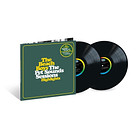
Who else would think of beginning a love song – after a French horn intro, no less – with the line »I may not always love you«? Yet just as the elegiac horn motif in »God Only Knows« seems to falter, shortly before the vocal enters, through hesitantly syncopated chords, the lyrics immediately change course: »But long as there are stars above you / You never need to doubt it / I’ll make you so sure about it.«
On the one hand, this sounds like a declaration of love with a long-term perspective: this love will last for as long as the universe above it exists. No modest claim. But it is not simply a confession made from the here and now; it is a promise for the future. As though the speaker of the lyrics had to reassure himself that love really can last. That does differ somewhat from the often straightforward declarations of love found in other pop songs.
Anything but an idyll
As the author Jim Fusilli emphasises in his book Pet Sounds, the reason for such »universal love« nevertheless lies in something very earthly: »God only knows what I’d be without you«, goes the refrain. The song’s speaker simply »needs her«, as Fusilli puts it. Otherwise, the first-person narrator would have no reason to live.
Existentially tormented questions of love run through the whole album. The music reflects this in similarly existential terms. Brian Wilson’s singing on »Don’t Talk (Put Your Head on My Shoulder)«, for instance, has in its bright delicacy something pleading about it. Unlike usual for The Beach Boys, he sings here without the background choir of his family bandmates. Over sustained chords, he invokes the present of a couple sitting quietly beside one another. Words seem unnecessary.
Wilson’s psychological troubles, which were only properly diagnosed and treated years later, can certainly be heard in the lyrics.
Still, the song does not convey an unclouded idyll. When, in the second verse, the words »This could be forever tonight« follow the opening line »Being here with you feels so right«, a string sextet enters with static low tones. At the latest in this moment, the song shifts into an almost threatening tension. None of which changes the fact that, alongside »God Only Knows«, it is one of the album’s high points.
Fusilli, incidentally, suspects a built-in trapdoor in this togetherness. The couple may have reached a point at which the woman wants to leave the narrator. That casts the words »This could be forever tonight« in a different light. The fact that Brian Wilson and his lyricist Tony Asher allow for such abyssal interpretations may have had to do with Wilson’s condition. His psychological troubles, only properly diagnosed and treated years later, can certainly be heard in the lyrics. The song »That’s Not Me« even carries the theme of identity crisis visibly in its title.
What can also be heard, by contrast, with unrestricted enthusiasm, are the many details of the production, with its finely nuanced dynamics and unusual arrangements. An accordion is no more out of place there than a theremin. Perhaps Brian Wilson’s handicap – being deaf in one ear – helped him concentrate all the more on details.
This record remains a wonder. A wonder that can move you deeply.