
To call something »entirely new« or »truly groundbreaking« is easily done. In most cases, it is not true. Another Green World is one of the rare exceptions. Here, Brian Eno draws on hardly anything that existed before; this record is not a synthesis of influences, but something generated almost entirely from within the artists involved. What had already worked was not the benchmark. Instead, Another Green World followed a simple principle: if we put person X in a room with person Y, something interesting is bound to happen. Let’s try.
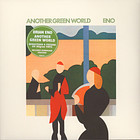
Another Green World
Eno’s third solo album is without parallel, especially in the context of 1975. No other record of that year was quite so wilfully singular – not Springsteen’s Born to Run, not Patti Smith’s Horses, not Pink Floyd’s Wish You Were Here, nor Led Zeppelin’s Physical Graffiti. All masterpieces, unquestionably. But none of them could be released tomorrow and still sound just as modern. Another Green World could.
Having come from glam rock as a former member of Roxy Music – and with his first two solo albums still moving in that orbit – Brian Eno here adopts a decidedly anti-rock stance. Another Green World unfolds according to its own logic and reveals itself almost entirely through intuition. The cutting four-note motif of the opener »Sky Saw« is hard to attribute to any single instrument; skewed sounds flutter through the background. Surely this is just the introduction, one thinks – the second track will be a proper song! But no: »Over Fire Island« consists largely of an instrumental bass solo. Vocals appear on only five of the fourteen tracks (or sketches).
Snake guitar and uncertain piano
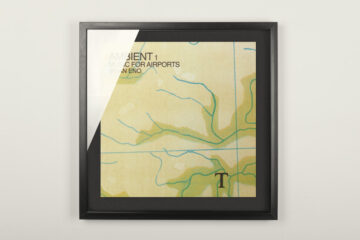
The towering highlights »The Big Ship« and »Becalmed« already point toward Eno’s later, canonical ambient works of the late 1970s – above all Ambient 1: Music for Airports (1978) – yet they rely even more heavily on expansive, emotionally charged harmonic structures.
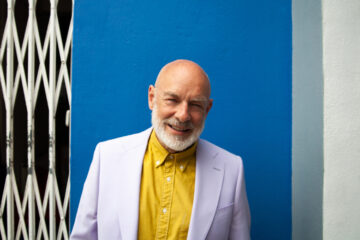
Brian Eno is something like a David Lynch of music: a curious guru of creativity, the ultimate art-school student, a theorist of aesthetic practice who nonetheless retains a certain amateurish openness. For him, the act of deciding is already half the artwork. Among the techniques he employed on Another Green World were self-devised instruction cards bearing phrases such as »use an old idea«, »only one element of each kind« or »work at a different speed«. The sounds that emerged were later credited under names like »snake guitar« or »uncertain piano«. Why? Because they described the sonic world of Another Green World better than any technical terminology could.
Anyone can be radical and shocking.
The album is also a convergence of extraordinary musicians: Percy Jones on fretless bass, King Crimson icon Robert Fripp on guitar, John Cale on viola, and none other than Phil Collins on drums. All of them were encouraged by Brian Eno to rethink their approach to making music. This would later become his defining trait: helping artists such as David Bowie, U2 and Talking Heads to step outside their comfort zones.
The remarkable thing is that, despite its radical experimentalism, Another Green World does not sound forbidding. Instead, it is inviting in its sheer beauty. To be radical and shocking is easy. Anyone can do that. To be radical and accessible at the same time – that remains one of the most powerful creative acts there is.