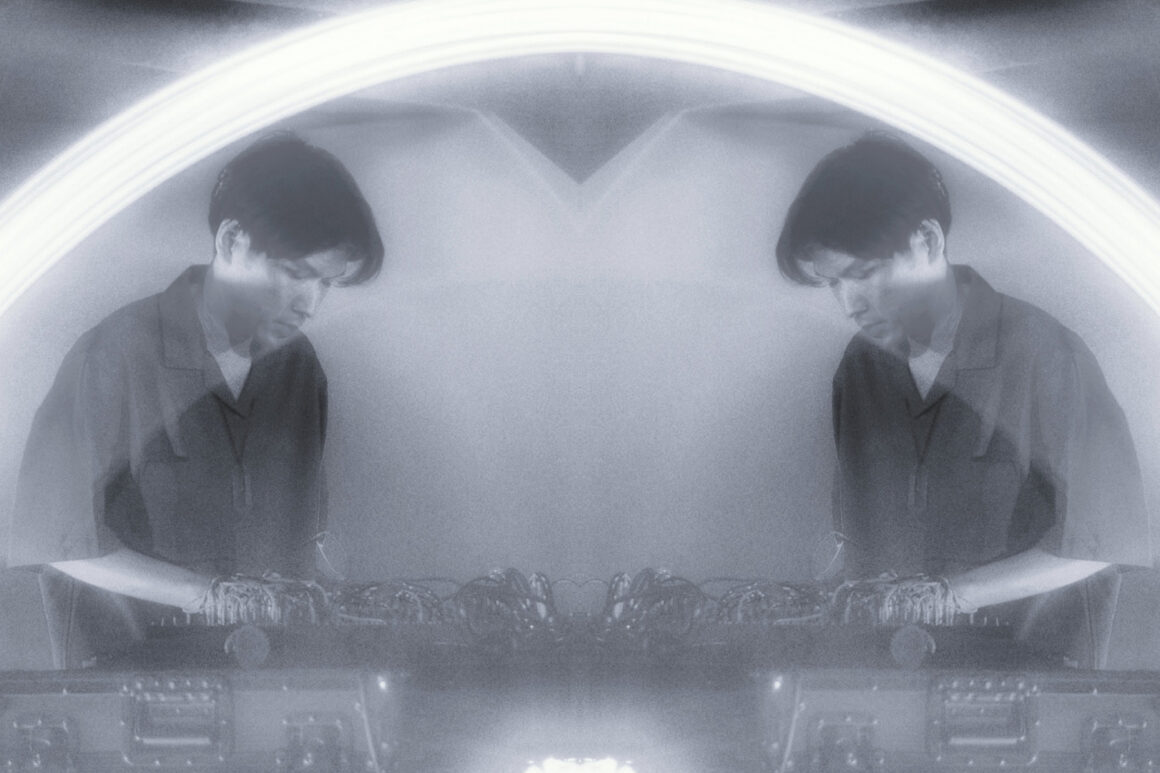
Hiroshi Ebina draws his sound from the small moments of existence. He takes up those instants that pass many people by unnoticed. This can be heard, in variations, on each of his albums. On It’s Always Autumn to Say Goodbye (2025), it is the empty spaces left behind by loss. On Silver Lining (2023), the light of a summer morning. And on his current album On Solitude, being alone late at night. Ebina shifts attention: away from the obvious, towards the inconspicuous.
The inspiration for On Solitude came from Wim Wenders’ Perfect Days. The large within the small. And the small within the small. It might be light. It might be a tree. It might be reading in the evening. None of it is spectacular. But in its simplicity, it is beautiful. »The film prompted me to explore the idea of seclusion and the sense of deep fulfilment away from the internet,« says the artist, born in Tokyo in 1987.

In »Your Mind Is Like The Ocean«, Ebina unfolds this solitude with a few synthesiser tones. With »One Step Closer To Awareness«, he moves towards techno. And on »Transience Permanence«, only a piano carries the track across its four minutes. »I sat down at the piano for the track and the chord progression emerged from the flow. I knew I wanted to focus on the piano and subtle ambient sounds, so the creative process was relatively effortless.« Towards the end, the piece shifts from minor chords into a major key to create contrast.
»I don’t begin with a concrete idea of what the album will be in the end,« says Ebina. »It is more of an ongoing dialogue within the recording process, during which I shape the themes of each track and of the album.« With Ebina, that dialogue is never loud.
»My style has changed a lot in recent years.« Ebina’s early work, he says, emerged above all from improvisation and experiments within the genre. These days, Ebina is moving towards more electronic and techno-oriented structures. »I still value fine textures and a minimalist approach, and these elements continue to shape my sound, no matter which direction I develop in.«
Depth in the surface
His current approach is perhaps more tangible than ever. Two tracks even feature lyrics – one by Hinako Omori, one by marucoporoporo. To grow as an artist, Ebina says, this was necessary. How far he has moved with his sound becomes especially clear because sound and voice connect with a rare organic ease for ambient. The voices add words: a level of meaning of their own, in a genre that otherwise often wants to be only sonic surface and tends to subordinate even singing to that
»I was impressed by how a minimalist approach could create such a deep and immersive soundscape.«
Ebina’s reaction to »Landing« by Taylor Deupree
Ebina was already making music as a child. As a teenager, he played Irish music and gagaku, the traditional court music of Japan. In his mid-20s, he began making ambient and electronic music. »I had been listening to this kind of music for some time, but when I discovered 12k, my approach changed fundamentally once again.« It was »Landing« by Taylor Deupree on the label that came into Ebina’s hands. »I was impressed by how a minimalist approach could create such a deep and immersive soundscape. That experience made me want to make similar music,« says Ebina, who also works with photography and visual art.
Last year, Ebina moved away from central Tokyo and now lives in a residential, quiet area. Many trees, much calm. There is a large audience for ambient in Japan, he says, but the community of artists itself is rather small. »To be honest, it can be quite difficult to differentiate yourself when you work strictly within the ambient genre.« That was also one reason to engage with vocals and techno-oriented elements for On Solitude.
Related reviews

With his albums, Ebina finds beauty in fleeting everyday life and in the everyday fleeting. Everything flows along Ebina’s dialogue with his sound. In »Your Mind Is Like The Ocean«, it is the synthesiser that carries the track; in »How To Belong To Yourself«, by contrast, it is not a soundscape but a rhythm. Hiroshi Ebina develops ambient much further than he would admit.