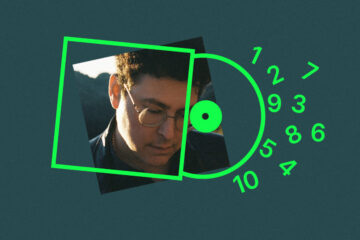
There is nothing that could be said about »The Disintegration Loops« that hasn’t been said a hundred times over. But let us begin at the beginning: William Basinski was about five years old when his piano teacher tried to kill him. Dressed in a nazi uniform, she attempted to run him over with a motorcycle while he was laying in bed. This didn’t happen once. The scene, drenched in sepia tones, kept repeating. Night after night.
It seemed oddly fitting that Basinski told me about this recurring nightmare when I asked him in a 2019 interview about his first memory. The scene he laid out seemed to encapsulate everything around which his work has revolved since his 1998 debut album »shortwavemusic« on noton. It is an oeuvre steeped in memory, guided by dream logic: always the same, yet slightly different. A recurring nightmare.

If you know very little about Basinski, it might come as a surprise that he is a cheerful dandy, a glamourous punk. His solo albums seem to stand in stark contrast to the person who makes it. So how come someone who makes this soul-crushingly sad, slow ambient drone music be so happy and upbeat? Maybe it is because he dreamt about death early, and came to terms with melancholy.
Grief Work, Not Melancholy
In his 1917 »Mourning and Melancholia,« Sigmund Freud argued that the way in which we deal with loss follows two possible trajectories. Mourning is a conscious and finite process during which a person comes to accept loss and ultimately finds closure. Melancholia, on the other hand, is the sort of unrelenting grief that is oblivious to what exactly it is that is missing from this world—a sensation so persistent and deep, yet so vague that it drives people insane.
There is a case to be made that Freud was wrong and that mourning, too, is not a process that can ever be completed, and that this is a beautiful thing. The name of Jacques Derrida is often mentioned in essays that engage with the »The Disintegration Loops,« but mostly in a second-hand manner. For many, the album is the pinnacle of hauntology, a term Derrida coined and that Mark Fisher has applied to music like Basinski’s.
During the digitisation process, the tape began to disintegrate further. Then the first plane struck the north tower of the World Trade Centre.
There is a case to be made that Fisher hadn’t understood Derrida, whom he once described as a »frustrating thinker.« Fisher’s own notion of hauntology rested on the idea that the music of The Caretaker, Basinski, and other artists were marked by an »overwhelming melancholy,« the persistent and deep, yet vague longing for »lost futures.« However, Derrida’s hauntology instead builds upon another Freudian concept: not melancholy, but grief work.
Grief work in Derrida’s understanding is a mix of mourning and melancholy—an infinite process of coming to terms with loss but never overcoming it. This keeps the dead alive as they continue to exist in the minds of those who bore witness to their existence. There is power and beauty in this coming-to-terms with melancholy, and we must imagine Basinski as a grief worker. »We’re still going through ›The Disintegration Loops‹ in world culture and politics,« he told me in 2019.
The End of an Era, the Beginning of Something New
In September 2001, William Basinski started to digitise the tape loops with slowed-down recordings of muzak he had picked up over the airwaves twenty years earlier, before he hung them up on a tree sitting in his Brooklyn loft and barely touched them for years. The tape had started to oxidise, corroded by the passing of time. It started to disintegrate further during the digitisation process. Then the first plane hit the north tower of the World Trade Center.
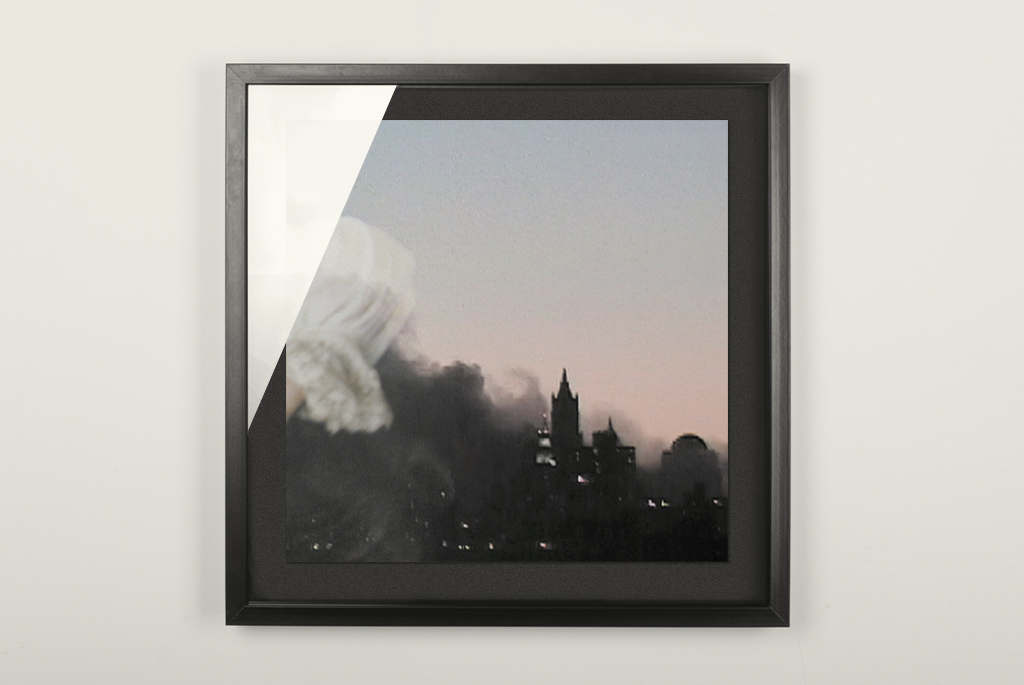
Once he had finished digitising the loops on the morning of the 11th of September, Basinski watched the Twin Towers collapse from across the East River. At some point, he started filming what he was bearing witness to. On the 12th of September, he set »dlp 1.1,« at 63 minutes the longest of the recordings, to the video he made. It was little more than an intuitive decision, something that just made sense at the time. It still does.
Muzak was originally intended to stimulate workers and simulate tranquillity, making it the perfect soundtrack to 20th-century capitalism.
The music on The Disintegration Loops moves slowly, seemingly guided by dreamlogic. Besides some added reverb here or there, it captures the slow decay of a type of music to which nobody listened with intent and that yet was everywhere in 1970s New York. Muzak was originally meant to stimulate workers and simulate calm, making it the perfect expression of 20th century capitalism and maybe also the American Dream.
This dream had been given new life by the end of the Cold War and the collapse of socialism. But on 9/11, the »end of history« that Francis Fukuyama had pompously declared in 1989, came to end, and with it, an era marked by what economist Alan Greenspan has called »irrational exuberance.« It was a death in more than one way—culturally, socially, politically, it marked the end of something many had considered to go on forever.
In the moment of this death, the »Disintegration Loops« were born and marked the beginning of grief work. Basinski released the album in 2002 on the label he runs with his partner James Elaine, 2062, and it has since taken on a life of its own. Orchestras performed the pieces, among other places also at Ground Zero. Even though it came to existence through a series of coincidences, it is hailed as a definitive masterpiece of 21st century music. Why?
Coming to Terms with Melancholy
A lot of ink has been spilled over The Disintegration Loops, and yet it is still hard to describe why the actual music is so captivating. These are, after all, relatively short slowed-down loops of elevator music. But while they are certainly beautiful in their own right, what really makes them fascinating is that they audibly struggle for survival in a very real and tangible way.
»dlp 1.1« is the best example of this. Over the course of 63 minutes, the music progressively starts to erode until the simple rhythm along with its anthemic brass motif that sounds more and more like a wordless wailing sound with every new repetition seem to sink into the abyss of silence. The percussion turns into mere crackle, the voices of individual instruments are being sucked into the air. But then, shortly after the 53-minute-mark, the music returns.
The play may not win the battle, but it will win the war against oblivion.
It now sounds different from how the piece started, reduced to its basic elements. And yet, it marches on, slowly but gracefully, towards its own death. It is as if »dlp 1.1« musters all its remaining strengths in these last minutes, fighting one final time against its inevitable demise. It does not win this battle, but it has won the war against forgetting. It still exists in the minds of those who bore witness, and lets them keep the memory alive.
This then is not the sound of »overwhelming melancholy,« but that of grief work, the sound of the beauty that lies in not forgetting and moving on, but living through catastrophe again and again as if it were an especially grim recurring nightmare. When Basinski told me in 2019 that »the work has relevance beyond 9/11,« he said this without arrogance. After all, »The Disintegration Loops« remain important to this day for precisely this reason.
9/11 was followed by war and increasing political instability almost everywhere in the world. Many geopolitical and social conflicts today are in some way connected to it. By more or less accidentally providing the soundtrack to the necessary grief work that should have followed when all the world did was trying to bring about closure by force, Basinski has made it possible to listen back and learn from this day—to come to terms with melancholy.