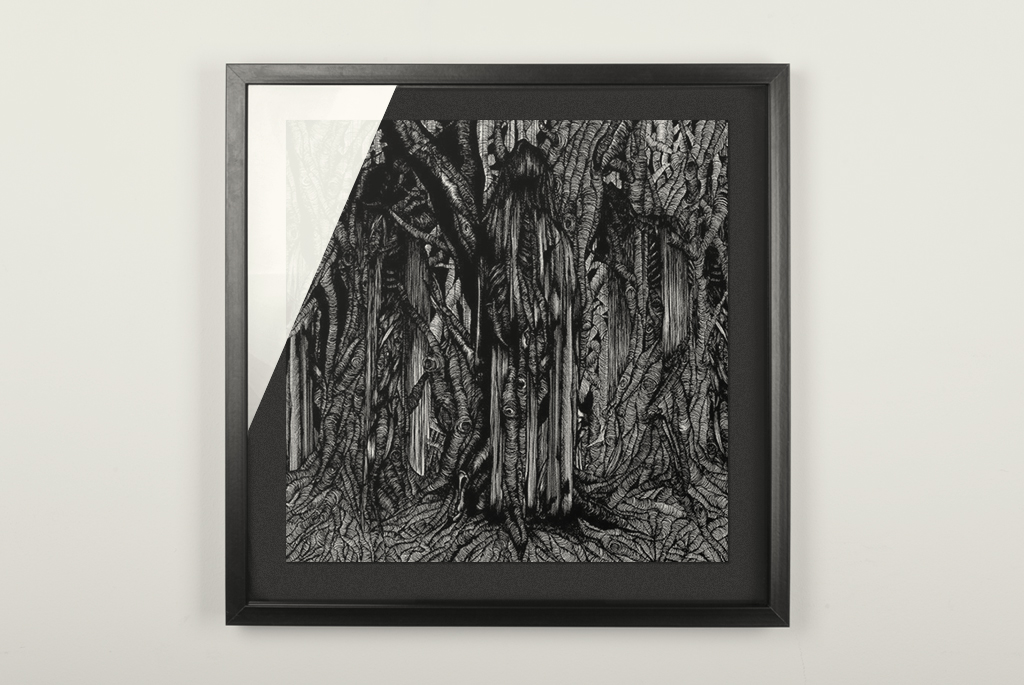
The title »Black One« is no coincidence – it deliberately echoes a metal genre that Sunn O))) had long been fascinated by. Their approach to black metal is not only evident in the choice of guest musicians – traces of which could already be found on the earlier White albums – but also stylistically. You will not find blastbeats here, at least not in any conventional sense: on »Orthodox Caveman«, guest musician Oren Ambarchi contributes drum sounds played backwards, barely recognisable as such. Screamed vocals, however, are plentiful.
»Cry yourself to ash«, goes one particularly brutal line in »It Took the Night to Believe«. The track is also the album’s greatest anomaly. Instead of their customary sustained tones, Greg Anderson and Stephen O’Malley employ a looping pattern of tremolo-picked guitar and a deep, sawing riff that interlock continuously, forming something like a black metal miniature. Over this, the “singer” Wrest gurgles his largely unintelligible words. In the background, a hoarse scream functions as a substitute drone. By Sunn O))) standards, it is a genuine earworm.
Black One
With »Cursed Realms (of the Winterdemons)«, the duo even bow explicitly to the Norwegian black metal band Immortal, who recorded the song in 1995 on Battles in the North at a far higher tempo and with full drum assault. Sunn O))) strip it down radically: for the first few minutes, guest vocalist Malefic snarls entirely alone, accompanied only by icy gusts of wind. Gradually, a construction-site-like rumble emerges, until a characteristic Sunn O))) drone layer settles over everything like vibrating permafrost.
Coffin recordings against the cult of self-optimisation?
Tracks such as »CandleGoat« lean more towards tradition. One might hear the stretched riffs as a homage to the Melvins’ drone classic »Lysol«. Elsewhere, Sunn O))) push the conventions of this otherwise highly reductive genre much further. In »Cry for the Weeper«, distorted brass sounds and unidentified sub-frequencies erupt first, before the inevitable guitar saws restore a sense of order. »Báthory Erzsébet«, meanwhile, spends the first half of its 16-minute runtime disorienting the listener with cave-like tubular bells, before Malefic’s gasping voice enters alongside the familiar drones. Allegedly, these vocals were recorded while he lay sealed inside a coffin.
When the album was released, some reviews claimed the music had triggered genuine fear responses. At the time, drone was occasionally hailed as a form of musical resistance – its relentless sustain interpreted as a refusal of self-optimisation and productivity. You can take that or leave it. Today, drone is primarily a metal genre, promising maximum immersion for those unafraid of permanent hearing damage at concerts.
With the benefit of 20 years’ distance, Black One can also be heard as flirting with self-parody. In retrospect, the idea of placing the presumably claustrophobic Malefic inside a coffin comes across as little more than macabre silliness – whether it actually happened or was merely a marketing stunt. Heavy as hell it remains.