
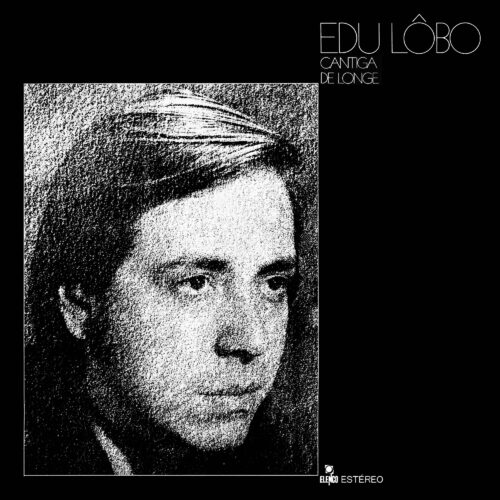
The Brazilian guitarist Edu Lobo came to prominence in the 1960s as part of the bossa nova wave, inspired by its leading figures such as Antônio Carlos Jobim and João Gilberto. He was also at the forefront of the transition to Música Popular Brasileira (MPB); his first band included, alongside himself, the future MPB star Marcos Valle and the singer Dori Caymmi. Lobo’s 1970 album Cantiga de Longe can also be seen as part of this transition, with the majority of the tracks composed by Lobo himself. His father, the composer Fernando Lobo, is honoured with a version of his catchy yet intricate ‘Zum-Zum’.
Edu Lobo plays throughout with a compact line-up. Alongside him on guitar are a bassist and a drummer, whilst Airto Moreira joins in as a percussionist. The arrangements are by bossa nova innovator Hermeto Pascoal, who can be heard playing the flute and piano himself. A major strength of Cantiga de Longe is Pascoal’s economical use of instruments and the subtle combination of repetition and complexity. In ‘Feira de Santarém’, for example, there are minimalist guitar and piano parts, with Pascoal deliberately using the piano only in places, much like the two backing singers, who subtly interweave the rhythm with swirling, loop-like figures. In Lobo’s restrained vocals, one can detect the influence of Gilberto, which is no bad thing, especially as Lobo adds his own distinctive touch with his deeper, more resonant voice. Forte.
Cantiga de Longe

