The year 2001 was shaping up to be a relatively uneventful one for the Western world. There was still a war going on in Chechnya, and an insurgency in Macedonia served as a coda to a decade of violence in former Yugoslavia. But in most of Europe, these conflicts seemed as removed as the Second Intifada or earthquakes in India and El Salvador. In the US, George W. Bush began his first term after a messy and contested election. And while the bursting of the dotcom bubble had brought a decade of »irrational exuberance« to an end and resulted in a light recession, the party went on.
The 1990s had been a time in which the underground went overground, says W. David Marx. »There was a sense that an alternative revolution was happening, that music was changing forever and that very difficult ideas were pushed on mainstream consumers,« the author of Blank Space. A Cultural History of the Twenty-First Century. By 2001, that moment had passed and the momentum had shifted: The rave-o-lution had quietly faded away and grunge’s rebellion had given way to nu metal’s unfettered aggression. Nevertheless, it wasn’t all rap-metal, Max Martin pop or casting show groups.
The first half of the year alone saw the release of debut records by future indie darlings The Knife, Broken Social Scene, The Shins, and Kings of Convenience as well as the Gorillaz and Alicia Keys. Daft Punk celebrated their triumphant return with Discovery, Tool released their opus magnum Lateralus, and Radiohead their follow-up to the iconic Kid A with Amnesiac. R’n’B and hip-hop reached new creative heights thanks to records like Aaliyah’s self-titled LP or Missy Elliott’s Miss E… So Addictive. And beyond all that, blink-182, Usher, Aphex Twin, D12, Wilco, N*E*R*D,, and Cannibal Ox also put out new records.
None of these records marked the beginning of a new movement or represented a revolution in music history, none of them redefined the culture or provided direction for the future. They weren’t capturing the collective consciousness, but made for a great individual listening experience. Just between late August and September 4th, bands and artists such as Björk, Slipknot, Mary J. Blige, Converge, and System of a Down put out albums that today are considered classics in their respective fields. The music industry might have been scrambling to sell them in a post-Napster world, yet it continued to offer persuasive products.
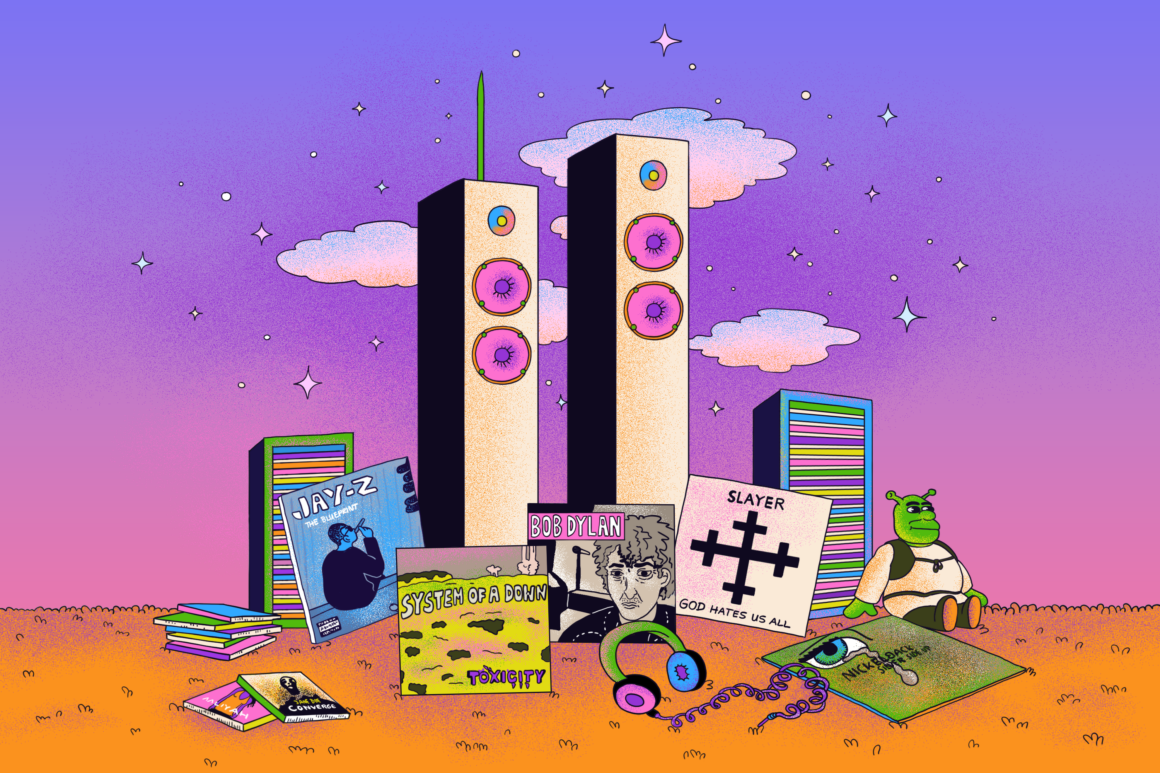
When record stores were preparing to open on September 11th, their crates were stocked with plenty of highly-anticipated albums: Bob Dylan’s 31st studio album Love and Theft, Mariah Carey’s soundtrack to Glitter, Jay-Z’s The Blueprint, Slayer’s God Hates Us All, or, well, Nickelback’s Silver Side Up. In the morning hours, William Basinski finished digitising some tape loops he had created decades ago, and hip-hop group The Coup were looking forward to finally getting the covers for their album Party Music printed. The artwork showed rapper Boots Riley and DJ Pam the Funkstress blowing up the World Trade Center.
Quiet Is the New Loud: Trauma and Self-Censorship
When the first aeroplane hit the north tower of the World Trade Center at 8.46 am, a previously relatively uneventful year for the Western world came to an abrupt end. A few minutes later, a second one hit the south tower. Less than one and a half hours later, both had collapsed. Around 3.000 people lost their lives that day and more than twice as many were injured. But the scope of the capital-e event that was 9/11 can hardly be measured in bare numbers: It marked the end of an era. Within just a few hours, the entire world had changed.
»9/11 marked the end of that left-wing pocket of US-American pop culture.«
W. David Marx
With its soothing sounds and lyrics about cosmic unpredictability, Enya’s 2000 single »Only Time« became the anthem for 9/11. In the wake of trauma, it wasn’t the only song to take on a new meaning. »NYC’s Like a Graveyard« from the anti-folk duo Moldy Peaches’ debut album, released on 9/11, felt uncannily prescient. The Weather Sisters’ »It’s Raining Men« or »Free Fallin’« by Tom Petty suddenly sounded macabre. A few days after the terrorist attack, media giant Clear Channel Communications even sent a list to radio programme directors, asking them to not include certain songs or artists in their playlists.
Among its 162 entries, the now-infamous memorandum did not only include songs that triggered memories of 9/11 or which, like Louis Armstrong’s »It’s a Wonderful World,« just seemed cynically jovial. It also listed various political songs and bands, including »all songs« by Rage Against the Machine. Clear Channel was quick to deny allegations of censorship. Not like that would have been necessary, says W. David Marx: »Everyone understood that you should not talk about US complicity in foreign policy or some of the more hard-left ideas that had been free to discuss in the 1990s.«
Marx’s Cultural History of the Twenty-First Century starts with 9/11 as the day that facilitated an already on-going paradigm shift in Western pop culture. »In the 1990s, there was a general alignment of alternative culture with the political left,« he explains. This tendency had already been in decline, but amidst the new atmosphere of self-censorship it seemed impossible to pick up on this failed revolution. »9/11 marked the end of that left-wing pocket of US-American pop culture for a good amount of time,« says Marx. Not really knowing what else to do, people went partying instead.
Oh, Inverted World: Hedonism, Retromania, Introspection
In Lizzy Goodman’s oral history Meet Me in the Bathroom. Rebirth and Rock and Roll in New York City 2001-2011, journalist Alex Wagner sums up the city’s post-9/11 attitude as one of »individual destiny-making,« fuelled by the realisation that »nothing matters, and everything is temporary.« The world had just ended, so why not get out and get hammered? This was, coincidentally, The Strokes’ whole vibe. The band had to postpone the hotly anticipated US release of its debut Is This It? from September to October to quickly replace the song »New York City Cops« (»they ain’t too smart«) with a less topical one.
When Is This It? did finally come out, it perfectly captured the zeitgeist, says W. David Marx. »They made stripped down music that was much more fun and danceable than grunge and rejected the sound of nu metal.« Trading the former’s ideological aspirations for ironic detachment and the latter’s red-hot aggression for cool flippancy, The Strokes and other upcoming New York bands like the Yeah Yeah Yeahs—who had released their debut EP in July—embraced unfettered hedonism when all the eyes and ears of the world were directed at their traumatised home town.
The music world offered a plethora of individual possibilities, but no sense of collective coherence; things were moving fast, but there was no real movement.
This was symbolic, but it was not like other subcultures had found more meaningful responses to the historic caesura that had just happened. From the White Stripes to Robbie Williams, whose album Swing When You’re Winning topped the charts in Europe by the end of 2001, a phenomenon that music journalist Simon Reynolds later dubbed retromania started to take hold. While some turned backwards, others turned inwards: Albums by Jimmy Eat World and Dashboard Confessional brought third-wave emo to the mainstream, a style almost entirely removed from its roots in political hardcore and punk.
It wasn’t just rock music that had little to say. In 1990s Europe, dance music had given birth to several mass and youth movements like Germany’s raving society and the different strains of the UK hardcore continuum. By 2001, they had been replaced by Aqua and the Vengaboys, 2-step and handbag house; caricatures of the subcultures that they were mimicking. Even hip-hop, still an innovative force thanks to Timbaland or underground acts like Techno Animal, approached self-parody in its pursuit of fame and money: The rap year closed with an Unplugged album by Jay-Z and the Roots, released just in time for Christmas.
Is This It? The iPod, Pop Idol, Poptimism
Paradoxically, 2001 was indeed a uniquely strong year in music and still 9/11 happened in a cultural void: The music world offered a plethora of individual possibilities, but no sense of collective coherence; things were moving fast, but there was no real movement. Popular music had again and again provided meaning and direction when nothing made sense and things did not seem to progress, but none of the path-breaking albums of that year did the same. People put on Enya or The Strokes’ retro-rock instead, opting for entertainment or escapism instead of new ideals for living.
It would be simplistic to reduce the post-9/11 cultural stagnation to an overwhelming sense of powerlessness in the face of unspeakable trauma. The economic crisis of the music industry also left its mark on the zeitgeist. Big record companies stopped investing in alternative culture and focussed on sure-shot blockbuster pop and creating new superstars out of thin air in front of casting show audiences. The infrastructure in which new ideas could thrive was built back for financial reasons.
In the meanwhile, technological progress also reshaped the cultural landscape. Apple introduced its iPod a month after 9/11. More than two decades after the introduction of the Walkman and a few years after the first MP3 player was made commercially available, it changed consumer behaviour in profound ways, argues W. David Marx. »The biggest effect it had was breaking people out of their genre silos. By the early 2000s, if you were a music fan, the expectation was that you were listening to all kinds of music.« This, for better and worse, further led to the erosion of previously existing ideological categories.
Music criticism had for decades been a bastion of clearly defined aesthetic criteria and moral distinctions, but also this changed. »There was a sense that pop music and especially hip-hop and R’n’B could be as, if not more innovative than rock music, which was a pretty obvious sentiment to a music fan at the time,« says W. David Marx in regard to the rise of what is today known as poptimism. While poptimism did have numerous positive effects, it also resulted in a post-modernist identity crisis that in many ways is still on-going: When everything is treated as potentially meaningful, nothing has any inherent meaning.
9/11 was not the cause of these developments, but it did serve as their catalyst. In New York and everywhere else, it facilitated a sense of individual destiny-making that replaced the urge to collectively shape culture. Why bother, in a situation when nothing mattered and everything seemed temporary, to create something new and lasting? Why try to change a world marked by radical evil and ennui? As uniquely strong a year 2001 was in music, it was also a truly uneventful year in cultural terms. An era had come to its end, but a new one did not begin.