
The year 2006 was the coming-of-age of a fresh sound that continues to resonate to this day. Deep, all-encompassing sub-basses, reduced soundscapes, claps like whip cracks, syncopated rhythm shifts in half-steps between breakbeat rave and downtempo sluggishness, a Pandora’s box of references from Reggae and Dub, Acid and Hardcore, Electronica and Folk. Dubstep stepped into the spotlight of the big wide world.

The invasion EP
The quiet revolution from London
Just as in Hip Hop, where six whole years passed between Kool Herc’s first party and Sugar Hill Gang’s global hit ‘Rapper’s Delight’, Dubstep had also been flourishing in its South London biotope for much longer. As a continuation of the UK bass continuum – which began in the 1970s with the sound systems of the Jamaican community in England, spilled over into the computer age in the late 1980s as Bleep Techno, and diversified through Hardcore, Jungle and Drum & Bass throughout the 1990s – the bass membranes were already vibrating a little more frenetically in 2001 at Pirate Radio Rinse FM and the FWD>> club series in London.
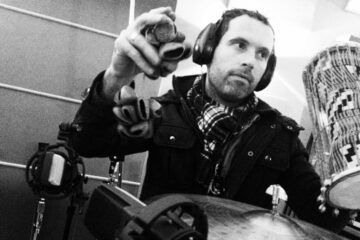
The record shop Big Apple Records became the hub for the freshest releases and exchanges within the still small Dubstep community. Later Dubstep poster boy Skream shopped and worked there, as did DJ Hatcha and Skream’s older brother Hijak. Producers such as Loefah, Zed Bias, Coki and, last but not least, Benga were regular visitors. In 2002, the short-lived label Big Apple Records was created, releasing nine records featuring the Who’s Who of the Dubstep community at the time. Benga is present on four of these releases (two of which were in collaboration with his long-time friend Skream) and made his debut there in 2003 at the age of just 15.
The rise to global recognition
When Benga’s ‘Invasion EP’ was published in 2006 as the label’s penultimate release, a considerable amount of deep, vibrating water had already flowed down the narrow Dubstep stream. Thanks to the culture of ripping, Big Apple had ceased to exist as a record shop two years earlier. From just two Dubstep releases in 2000, the number had grown to 464 six years later.
Thanks to trendsetting radio DJs John Peel and Mary Anne Hobbs, Dubstep slowly entered the consciousness of the British mainstream. With her curated compilation Warrior Dubz (Planet µ), Hobbs gave the wider world outside Croydon, London, an insight into the exciting bass landscapes of the British underground.
Trotz der wabernden, nautisch-tiefen Bässe, der starken Reduktion der Klangräume und düsteren, drückenden Atmosphäre eröffnet jeder Track ein eigenes Fenster der Ausdifferenzierung und Selbstständigkeit.
Viewed from the outside (i.e. beyond London), Dubstep began its triumphant rise in 2006. In Berlin, it was becoming the hottest thing happening thanks to the Sick Girls and the Grime Time and Revolution N°5 party series at WMF. People even forgave the Sick Girls for stumbling through most of their track transitions at that point, because they always had the hottest tracks from the UK on deck. DJ Maxximus, on the other hand, gave the sound a party home in various German cities with Basstheworld. Kode9, Pinch and Digital Mystikz featured in the film Children of Men. A year later, Britney Spears incorporated the wobbling bass of Dubstep, while US producer Skrillex – staying true to the spirit of his homeland – inflated everything to XXL proportions and turned it into the beach party variant Brostep. Today, the influence of dubstep can be traced not only in the syncopated, bass-heavy styles of contemporary techno, but also in the fast-paced hip hop of Run The Jewels and the K-pop of Blackpink.
A snapshot while drifting apart
The London Dubstep scene was already ambivalent in 2006. When I interviewed several Dubstep producers for a feature in the Goon Magazine in early 2007, their perspectives already oscillated between euphoria and boredom. Milanese (Warp Rec.) and Boxcutter (Planet µ) lamented the interchangeability and limitations of many Dubstep tracks. Shackleton (Skull Disco Rec.) politely but firmly declined any interview that would associate him with Dubstep. Pinch (Tectonic Rec.), Scuba (Hotflush Rec.) and Appleblim (Skull Disco Rec.), on the other hand, were still intoxicated by the sound and celebrated the versatility of the genre. For Cyrus (Tectonic Rec.), it was simply the »best thing to come from the UK«.
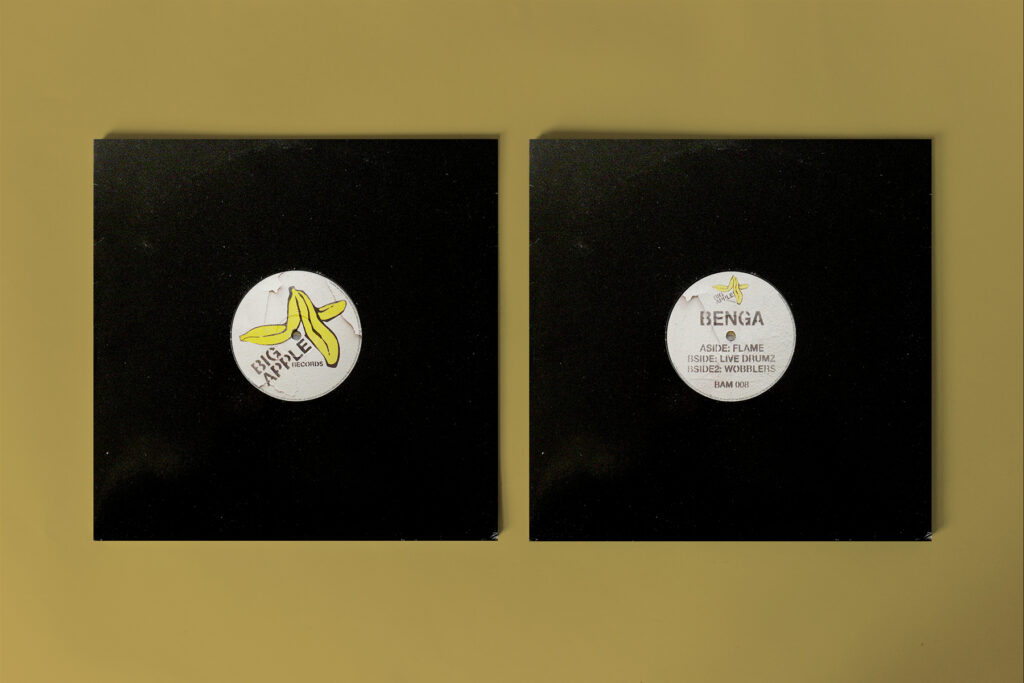
Benga’s ‘Invasion EP’ still belongs to the euphoric camp. In the interview, Milanese expressed his wish »to hear more album stuff being done. Obviously fat beats and dirty bass kill the dancefloor and that’s great but I’d like to hear more stuff that I can listen to at home for more than about 2 minutes before skipping to the next track because it’s not going anywhere.«
With seven tracks on 2×12”, the Invasion EP was only a mini-album, but it easily lived up to Milanese’s expectations. Despite the obvious genre-defining elements of the wobbling, nautically deep bass, the strong reduction of sound spaces and the dark, oppressive atmosphere, each track opens its own window of differentiation and independence. In 2006, Benga captured a snapshot of the dynamic drift of the scene that perfectly outlined the potential that Scuba saw for dubstep in the interview: »To me, Dubstep is fusion. The key is that everything sits alongside everything else, without splitting it down into sub-genres.«