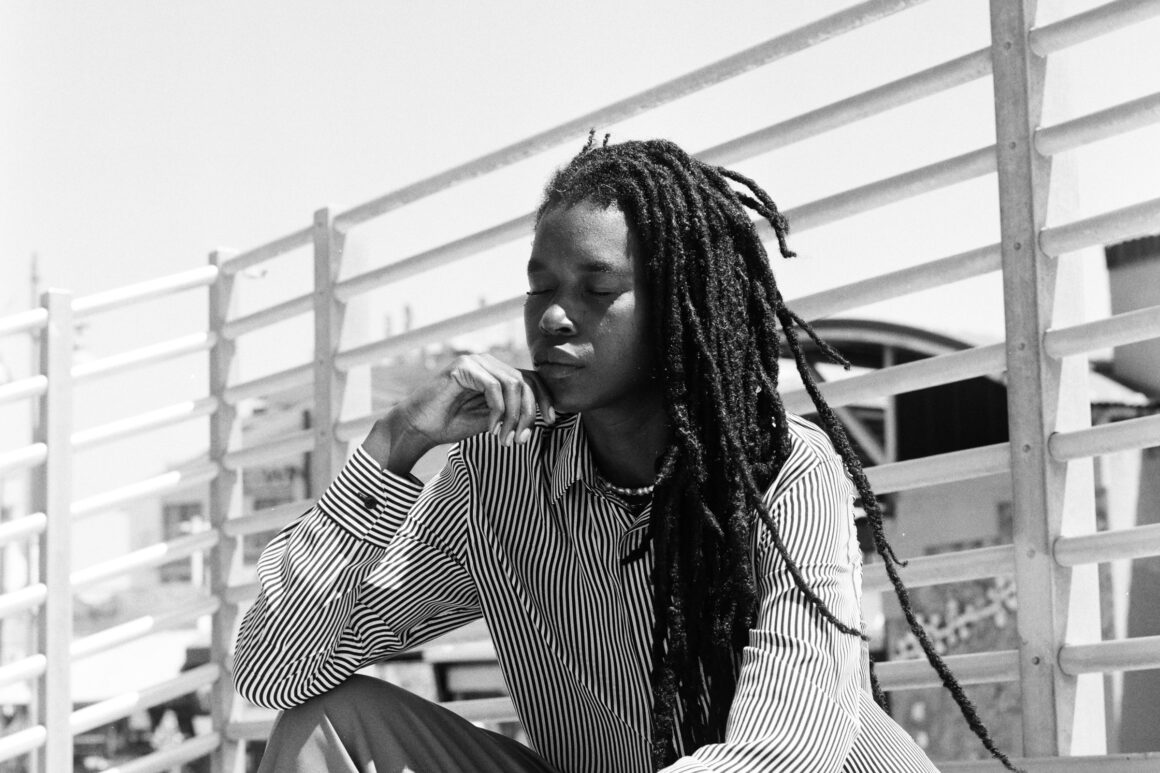
Many years ago, I read an interview with Saul Williams in Spex that comes back to me whenever I think about the Philadelphia-based musician Camae Ayewa, aka Moor Mother. In it, the New York spoken-word poet traced the word ‘person’ back to the Latin per sonare – ‘to sound through’ – arguing that we are ‘beings of sound’. »If we primarily define ourselves as such,« he said, »we act according to sound vibrations. As persons, we must therefore direct all our attention towards what we put into words.«
Humans are beings of sound. What Saul Williams frames metaphorically, the philosopher Peter Sloterdijk confirms on an ontological level when he asks: where are we when we listen to music? His answer: we do not stand opposite sound as the seeing subject stands before an object. Sound is inside us. Music sets us vibrating.
The sociologist Hartmut Rosa describes in his book Resonance what music fundamentally does. For him, it is capable of expressing or generating »all kinds and shades of relationships: rupture, loneliness, abandonment, hostility, alienation, tension – but also longing, refuge, shelter, love, responsiveness.«



Black in the moment
In einem Text im erzählt Camae Ayewa, wie sie 1989 – damals zwölf Jahre alt – bei einem Public-Enemy-Konzert die ermächtigende Kraft von Musik erlebte. »When Terminator X said: ›Put up your fists‹,« erinnert sie sich dort, »there were all these Black people with their fists up, and there was my little fist.« (Als Terminator X rief: »Fäuste hoch!«, standen da all diese Schwarzen Menschen mit erhobener Faust – und da war meine kleine Faust.) Seither nennt sie sich selbst eine Rapperin.
In an article in We Jazz Magazine, Camae Ayewa recounts how, in 1989 – aged twelve – she experienced the empowering force of music at a Public Enemy concert. »When Terminator X said: ›Put up your fists‹,« she recalls, »there were all these Black people with their fists up, and there was my little fist.« Since then, she has called herself a rapper.
Moor Mother’s early albums, Fetish Bones (2016) and Analog Fluids of Sonic Black Holes (2019), are marked by a paradoxical simultaneity. No linear song structures, no hierarchy of elements. Samples from different eras, street-level field recordings, inarticulate screams, whispered poetry, industrial noise. Layer upon layer, without one dominating the other. This is not rap. Nor is it collage in the traditional sense, where elements are neatly arranged side by side. It is superimposition – a sonic palimpsest. The past is not erased; it shimmers through the present. Acoustic manifestations of Black Quantum Futurism.
Together with the writer and lawyer Rasheedah Phillips, Ayewa founded the collective Black Quantum Futurism. In 2015 they published their manifesto Black Quantum Futurism: Theory & Practice (Volume 1), proposing that reality can be re-experienced by shifting temporal axes. This enables futures to be imagined – or brought about. In 2021, Phillips and Ayewa were selected for a residency at CERN, operator of the Large Hadron Collider, where they worked with physicists on a project exploring CPT symmetry (charge, parity, time reversal). Afrofuturism meets quantum physics. Theory becomes practice.
Related reviews

SUMAC & Moor Mother
The Film
Moor Mother
The Great Bailout
Irreversible Entanglements
Protect Your Light
Moor Mother
Jazz Codes
The central thesis of Black Quantum Futurism is that linear time is an instrument of domination. ‘Manifest Destiny’ and the ‘Westward Expansion’ – the supposedly God-given mission of Americans to spread across the North American continent – were not only the conquest of land (the appropriation of space), but also the conquest of time (the power to determine the future). Past, present and future exist simultaneously and shape one another. Moor Mother described this idea to Vice as »a new language of healing, memory, and justice that can be transmitted and used as a technology«.
I recently read the following passage in Rachel Kushner’s novel Creation Lake: »The spirit […] reproduces itself, for centuries, for millennia, from the dead to the living. Each of us inherits codes, blueprints, a bundle of instructions – call it what you will – from those who came before us, down into the deepest sediments of time.« Coincidence? Being human? I put on Jazz Codes.
On »Umzansi«, the opening track of Jazz Codes (2022), the concept of Black Quantum Futurism is cast into song form. »Quantum, black in the moment / It holds the time and memory of all your mothers and grandmothers before.«
And: »Allow time to emerge from its timeless degrees of freedom / And take up as much space within the moment as desired and needed.« The music sounds like it comes straight from a particle accelerator: quanta race, collide, decay, entangle. Vocal fragments from all directions, particles of electronic beats and Mary Lattimore’s harp – an acoustic field governed by physical laws.
Communication is crucial
Moor Mother’s approach also recalls Gil Scott-Heron, particularly in the way poetry, politics and music are conceived together. Scott-Heron and his musical partner Brian Jackson took nothing less than the entirety of the ‘Black experience’ as their subject. In 1985, Scott-Heron told The Wire: »We described that experience as 360 degrees, and whatever fell inside those 360 degrees was fair game for us to cover.«
This 360-degree approach also reveals something else: although every human is a person, a being of sound, not everyone has a voice. Moor Mother makes audible what has been silenced. She creates spaces in which the past and present exist simultaneously. This opens up possibilities for articulating the unheard, recontextualising the silenced, and giving voice to the voiceless.
Her album The Great Bailout (2024), for instance, confronts the Slavery Abolition Act of 1833, which compensated slave owners while leaving the enslaved empty-handed. In the nine-minute blues »South Sea«, she hammers the question: »When and where do the ancestors speak for themselves?« Moor Mother does not doubt that they speak – only that anyone listens. The structures of time silence them.
She creates spaces in which the past and present exist simultaneously. This opens up possibilities for articulating the unheard, recontextualising the silenced, and giving voice to the voiceless.
To be heard, then, requires more than a voice. It requires an other. Ernst Bloch writes in The Principle of Hope: »To know oneself, the mere I must go to others. In itself it remains sunk into itself; the interior lacks the counterpart.« The other eludes availability – it is not an object, a commodity, a data point. Voice emerges only in the other, in encounter, in musical dialogue. At the same time, it becomes a voice for others. Moor Mother moves through scenes and communities. She listens to what sounds between them: the gaps, the entanglements, the echo of collective experience. Her art is not self-assertion, but relational labour. She is a medium, not a centre.
Through her work, Moor Mother addresses multiple communities at once. With SUMAC, she reaches the post-metal scene; with billy woods, experimental hip-hop; with DJ Haram as 700 Bliss, the clubs; with Irreversible Entanglements, free jazz. Speaking about Irreversible Entanglements in The Wire in 2023, she said: »We’re interested in reaching as many communities as we can […] with the sounds that everybody deserves.« This applies to all her projects. No hierarchy of scenes. No choosing one community over another. No ranking, no prioritisation.
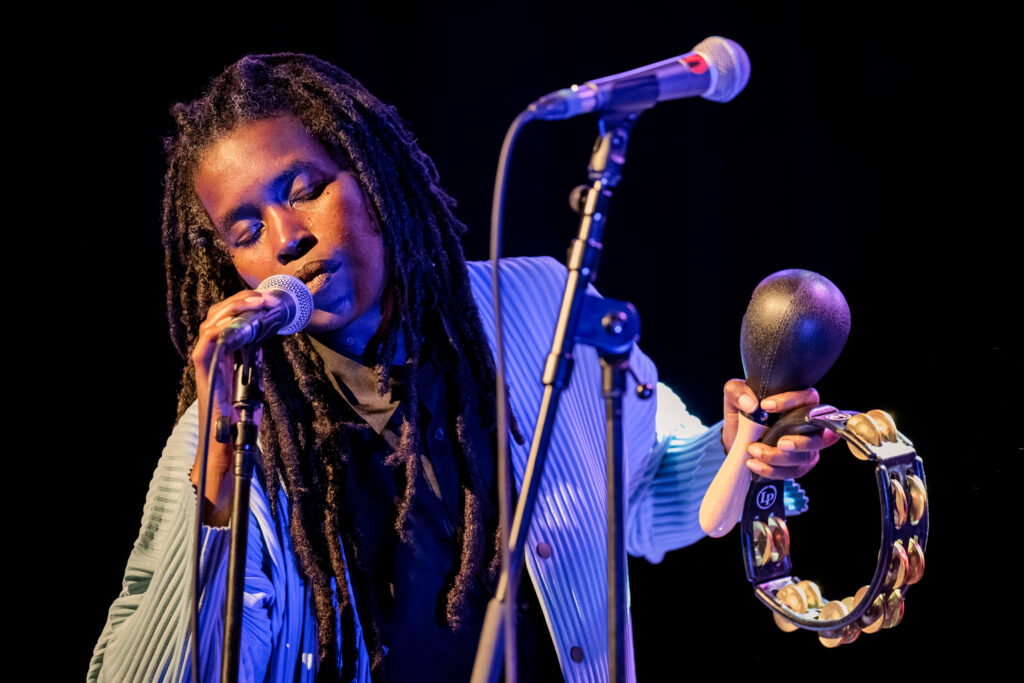
Moor Mother war die letzten Jahre ein oft und gern gesehener Gast beim Enjoy Jazz Festival (Foto: Wilfried Heckmann) 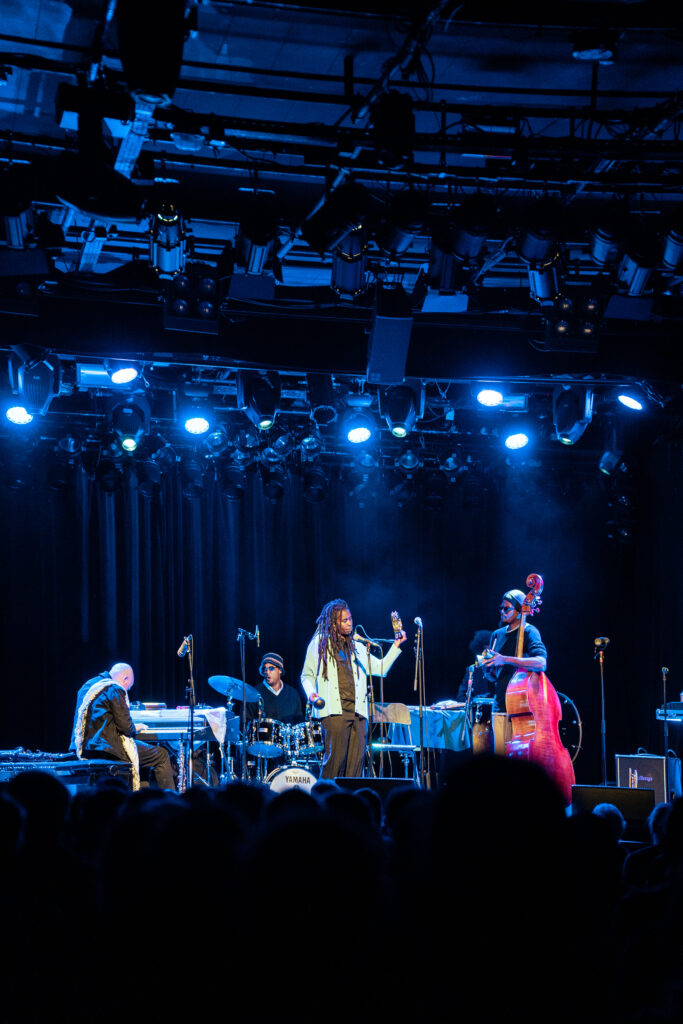
Zum Beispiel mit Irreversible Entanglements live am 15. Oktober 2025 in der Alten Feuerwache in Mannheim (Foto: Elisabeth Samura) 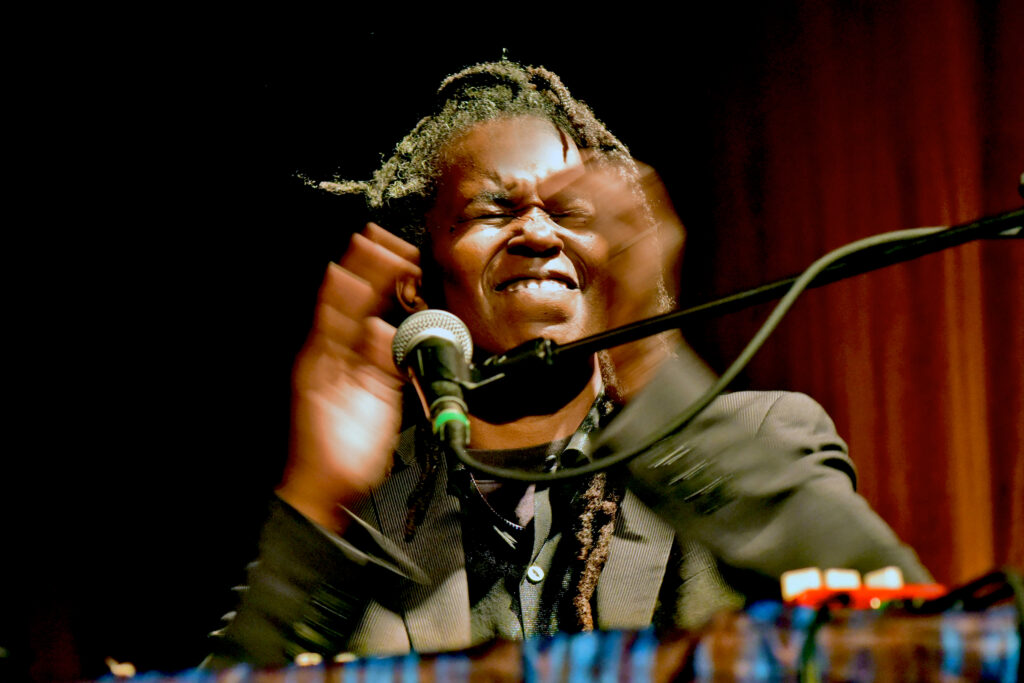
Oder beim Konzert mit Lonnie Holly am 18. Oktober 2023 in Mannheim (Foto: Manfred Rinderspacher) 
Beim Poetry Workshop als Teil ihrer Residency beim Enjoy Jazz Festival 2023 (Foto: SCHMOTT ) 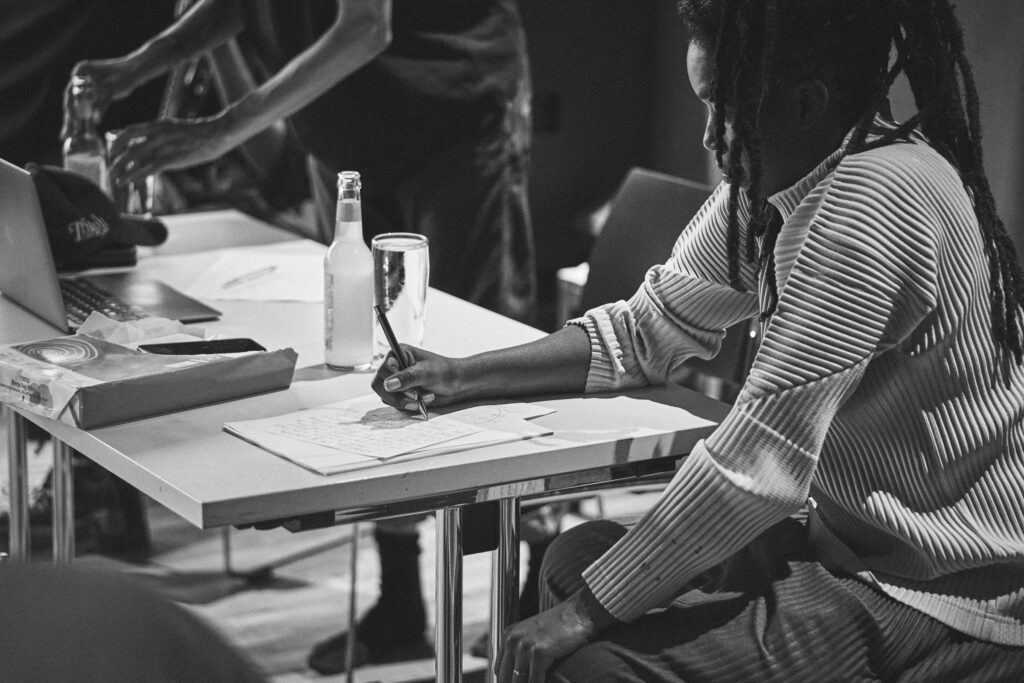
»Quantum, black in the moment / It holds the time and memory of all your mothers and grandmothers before« (Foto: SCHMOTT) 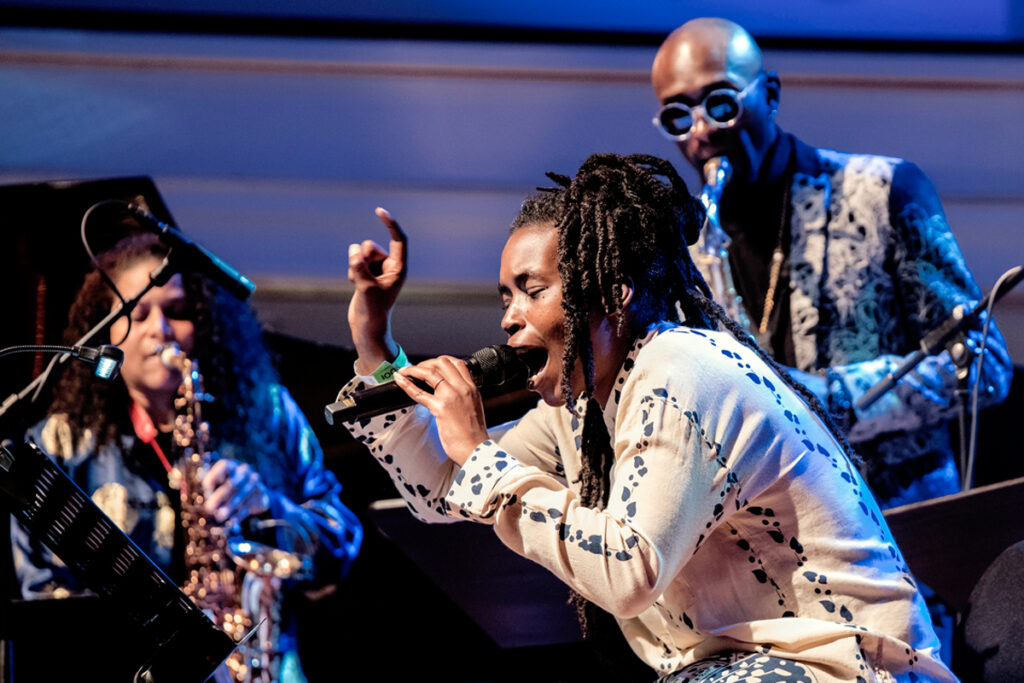
Als Teil von Denardo Colemans Tribute to Ornette Coleman »The Shape of Jazz to Come« im BASF-Feierabendhaus in Ludwigshafen (Foto: Wilfried Heckmann) 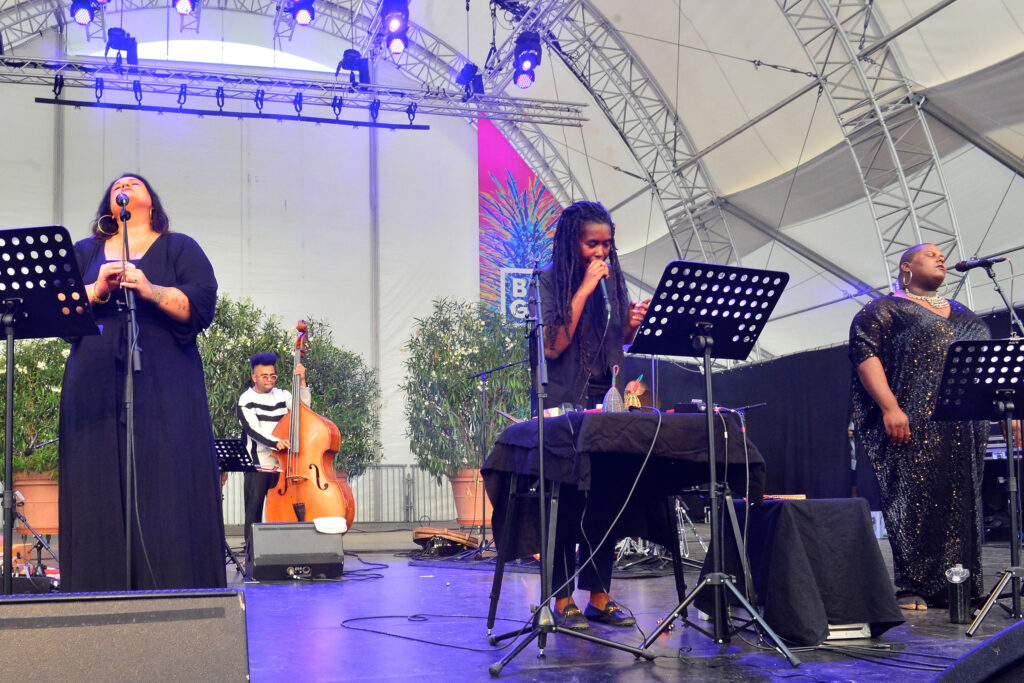
»Jazz Codes« spielend am 29. Juni 2023 bei der Bundesgartenschau in Mannheim. (Foto: Manfred Rinderspacher)
In October 2023, Moor Mother was due to perform with saxophonist Archie Shepp at the Enjoy Jazz Festival. He had to cancel. Instead, she recorded spontaneously with flautist Nicole Mitchell and pianist Nduduzo Makhathini. The title One for Archie references Shepp’s Four for Trane. Her performance texts echo Shepp’s track titles; her phrasing follows his saxophone lines. In this way, Archie Shepp’s music becomes present even in his absence. His voice is audible, though he is not there.
On 15 October 2025, Moor Mother returns to the Enjoy Jazz Festival in Mannheim with Irreversible Entanglements. She subtly directs the quintet, arranging – with two microphones, one with reverb, one dry – voices from the past and binding them to the present. She resists the spotlight, addresses the audience directly; the encore is played in the middle of the crowd. As if to say: this music is not simply here. It is part of you – and always has been.
What does such collaboration look like in practice? Asked about working together on BRASS (2020), billy woods describes the process as productive precisely because Moor Mother dissolves expectations: »I am always aware that Camae can, or could, do anything. She is an artist whose range and creative instincts can take them anywhere.« This openness demands constant communication. Exchange itself becomes a compositional method. billy woods cannot plan ahead; he must respond to what emerges: »A verse, a poem, a beat, or something else I didn’t even think of.«
The simultaneity of the non-simultaneous
This openness also shapes her engagement with history. Moor Mother speaks of specific events and means the universal. She speaks of the past and means the present. She follows the threads – not her history, but ours. The pronoun shifts: from individual to diaspora. From Philadelphia to Liverpool. From 1833 to today.
When The Guardian asked why an American artist is interested in British history, she replied: »I’m not removed from the UK. As an African, our story runs all through the UK. I’m just following the threads. Where we’ve been. What has happened to us. How we overcome it.«
Moor Mother follows the threads. They do not lead into the past; they pass through it into a time yet to be constituted. In doing so, she sets them vibrating. All we really have to do is listen.
This piece was originally written in German; some quotations are translated from German-language sources rather than taken from existing English editions.