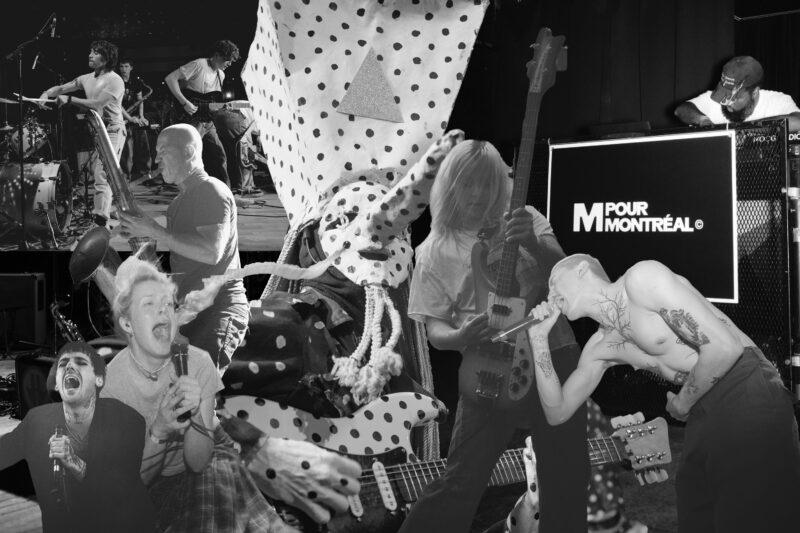
By February 2005 at the latest, Montréal was no longer anyone’s secret. In an article in the New York Times, the journalist David Carr declared Montréal the next great music city. After Seattle, Athens and Austin – “even Omaha had its 15 minutes” – it was now the turn of a Canadian city. Carr treated it, half in jest, as the next stop for American music hype: “So which American city is the next stop on this fickle, itinerant history?” Either way: Godspeed You! Black Emperor, Arcade Fire, The Unicorns – the music industry had found a new place to long for. Montréal became a label, and it was stuck on bands and musicians from Toronto too, Broken Social Scene among them. The scene was bigger than its geographical borders. The myth took on a life of its own. Still, it wasn’t made up.
According to the 2021 census, only 11.9 per cent of people in Montréal speak English only, 27.2 per cent French only, and 58.5 per cent both. “Many Montrealers move between French and English within a single conversation, and the music scene reflects that,” says Audréane Lafond, who places music in film and advertising for several labels, Indica Records among them. In 2019 Corridor became Sub Pop’s first francophone band, without ever switching to English. Lafond: “Nobody can fake their own language.” The catch lies elsewhere: “Québécois French is still sometimes heard as a regional variant rather than simply as French.”
“Montréal is also a crossroads,” says Emilie Asselin, part of the management team behind Angine de Poitrine. The two polka-dotted math-rock aliens come from Saguenay in the province of Québec, some 470 kilometres north of Montréal, on the fjord. The city has fewer than 150,000 inhabitants. A surprising number of musicians come from there, says Asselin. “We sometimes joke about what’s in the water.” Her own theory is more sober: “It’s an even smaller community, so people stick together even more tightly, and being far from big urban centres leaves room to create.” And yet: “There’s something magical about Saguenay.” Many of these artists eventually move to Montréal. Internationally, that becomes the “Montréal scene”. “Honestly, ‘the Quebec scene’ would be more accurate.”
Cheap and cheerful?
The World Cities Culture Report 2025 counts 219 live music venues in Montréal. In 2025 the city launched a funding programme of its own for small venues with fewer than 1,000 seats and at least 35 shows a year. Then there are 28 music festivals, among them MUTEK, running since 2000: a festival of electronic music and digital art with offshoots from Mexico City via Barcelona to Tokyo. Guinness World Records has listed the Festival International de Jazz de Montréal as the world’s largest jazz festival since 2004; according to the Canadian government, it draws more than 1.2 million visitors a year. Add to that a label scene ranging from post-rock via francophone pop to club music: Constellation, Arbutus and Mothland, Bonsound and Secret City, Priori’s NAFF Recordings or Tiga’s Turbo Recordings. Sixty-four per cent of the population attended at least one live music event in the past year.
Audréane Lafond finds the picture incomplete. “It is indeed a city where creators find each other,” she says. But “the venues and festivals behind the legend remain fragile”. The nightlife policy the city launched in 2024 – which includes funding for soundproofing in smaller venues – is “a real step”, she says, “but the small independent rooms where emerging acts actually begin say it isn’t enough. The tourism pitch celebrates the creativity while rarely mentioning the rent, the condos and the noise bylaws artists and organisations [fight] to keep their stages.”
Montréal might eat its young / But Montréal won’t break us down
— “This is the Dream of Win and Regine”«”, Owen Pallett, 2005
I leaf through the 2014 issue of Flaneur devoted to Rue Bernard. Each issue of the magazine portrays a single street. Rue Bernard runs for two kilometres, linking the Montréal neighbourhoods of Outremont and Mile End. Where it meets Boulevard Saint-Laurent, Ubisoft, one of the world’s leading games companies, moved into the Peck Building in 1997. In his piece, the writer Fabian Saul notes: “Mile End becomes younger and younger and hipper and hipper and more expensive and more expensive.” And his punchline: “The new fights of de-territorialisation are the real ones of raised rents and the virtual ones of computer games.”
Jeff Waye also appears in Carr’s New York Times piece. The Canadian music entrepreneur recalls arriving in Montréal in 1991: “When I moved here in 1991, I was living in a nine-and-a-half room apartment with two other people, and I was paying $175 a month.” A far cry from today. Between 2019 and 2025 alone, asking rents for two-bedroom flats rose by 70.8 per cent, from C$1,130 to C$1,930. Even so, Montréal remains cheaper than Toronto and Vancouver. The musician Lauren Spear, aka Le Ren, came to Montréal because “it was cheap and cheerful”. “Montréal feels like the last big Canadian city where you can still (sort of) afford to be an artist.” When she first arrived, she paid “as little as $150 a month for a room (though, to be fair, I shared it with a friend and we slept in the same bed lol)”.
“The truth of a city lies in its inhabitants.”
— Simone de Beauvoir
“Everyone plays in each other’s projects, goes to each other’s shows, and wears each other’s merch,” says Le Ren. Emilie Asselin sees this less as romance than as necessity. Music from Québec “doesn’t travel easily”, the market is limited, and “there are real ceilings on how far a career can grow, so the scene is fairly DIY: it organizes itself however it can, and that brings people together.”
Then there’s public money. “Most public funding programs cover around 50% of a project’s budget,” says David Dubé, head of M for Montréal, the festival where Grimes, Mac DeMarco and Patrick Watson played early on. “It helps a lot, but you still need to find a team capable of matching the other half to actually kick off the project.” “You can get support and still keep that punk mentality of making things happen yourself,” adds Mikey Rishwain Bernard, who curates M for Montréal with Cindy Andrey. DIY with a safety net.
In the same issue of Flaneur, a few pages before Saul’s piece, the writer and actor Mathieu Leroux recognises the whole city in Rue Bernard: “Within the two extremes of Rue Bernard stands everything that I love about Montreal: multi-ethnicity, vibrant culture, good architecture, great food, English and French (and Spanish, Italian, Russian, Hebrew, etc.) old and new, rich and not-so-rich, damaged and spotless, queerness—things that don’t matter to you, or that you don’t care for.”
An evening at M for Montréal 2025, at Les Foufounes Électriques on Rue Sainte-Catherine. Nirvana are supposed to have played here, I’m told again and again. But the clubs live off what is happening now, not off what the walls once saw. Three hours, two stages: alternative, new wave, hardcore, reggaeton, electroclash, noise rock and hip-hop. Nothing sounds like anything else, and yet it all fits together. Not because Montréal has a “sound”, but because of the crackle of the unknown.
Rendezvous in the backyard
When M for Montréal is on, Le Ren likes to “bike around Montréal, catching the beginning of one showcase and the end of another”. Mile End, the Plateau and downtown are close together; “you can easily catch three different things in one night,” says Mikey. “With bars open until three, the conversation can keep going outside until four.” This year Le Ren is on the line-up herself. “I get to wake up in my own bed, play a show, and be back home in time for a bath. That’s rock ‘n’ roll baby.”
In 2025 Angine de Poitrine played to around 2,000 people at Ausgang Plaza during M for Montréal. Afterwards came 100,000 at the Montréal Jazz Festival and 50,000 at Osheaga. A launchpad story? The duo wasn’t discovered there, says their manager Emilie Asselin: “By the time they played M for Montréal, their discoverability was already skyrocketing.” But in the audience sat a booker who now represents the band across Europe and Oceania.
Mikey Rishwain Bernard isn’t keen on the word “showcase”: “Even ‘professional showcase’ sounds a little too industry for how we see M. To me, it’s more of a rendez-vous for creative, open-minded people. There’s business happening, of course, but it starts with people connecting over music.” Cindy Andrey adds that the festival gives artists guest-list spots “so they can invite friends or members of the public to shows that would normally be reserved for industry professionals”. In some of the larger venues, audiences and delegates share the room. Asselin knows the other side. “As delegates, we’re often there to do business, and we’re not always able to fully take in the music,” she says. “It starts to look like a financial product, something marketable. I think about that often, and I find it a little frightening.” A showcase, she says, remains “an extremely precious tool for an artist, and we should work to keep it precious and mindful.”
M for Montréal takes place from 18 to 21 November 2026. On the line-up, among others: Le Ren, Population II, Yoo Doo Right, Zouz.
This piece was produced in collaboration with M for Montréal. There were no conditions regarding its content. It was originally written in German; some quotations have been translated from German-language sources rather than taken from published English editions.